
“The indifference is impenetrable and reliable and distributed across centuries, and I am stupidly hurt when my friends can’t see that.” – Claudia Rankine, “tiki torches”
It’s a week where I can feel myself learning. 2026 is Year Three of reading at least a book a week, and I gotta say, this is a good way to live life. Busy! But that’s not the books’ fault. They’re books, they don’t control the rest of what I have to do. This week, I’m reading a writer who is always instructive. A writer I really, really respect. Someone who reaches rarified heights in terms of intellectual rigor, artist experimentation, and following obsessions. Yet I feel like I have a more nuanced take on this week’s text than I would previous texts.
I want to be clear that reservations about this book are not directed at the author’s lived experience, nor the urgency or high stakes nature of the subject matter the author is dealing with (racism, colorism, sexism, white privilege, among others). Whereas before, I might have simply marveled at this writer’s mind, technical ability, and the necessity of reading her, here in 2026? I am approaching books, and what they have to offer people, slightly differently. In short, while I do believe that reading is an important component of how we Kill The Empire, I’ve maybe lost some of my belief in the magic of “one simple text to cure all your unconscious biases.” Not that that’s ever how I felt, not wholly.
One thing I am interested in books doing: portraying people in all of their three-dimensional experiences. Books where the focus is on the oppression of Black people and Black pain—again, necessary though they might be—are only one side. I am wary of us (book readers) reducing marginalized people to only their suffering and oppression. Bob and I get into it a little bit on this month’s The Line Break, where Bob reads Rita Dove and I read upfromsumdirt. It’s a good episode! Apple | Spotify | SoundCloud
What I’ve Been Reading This Week
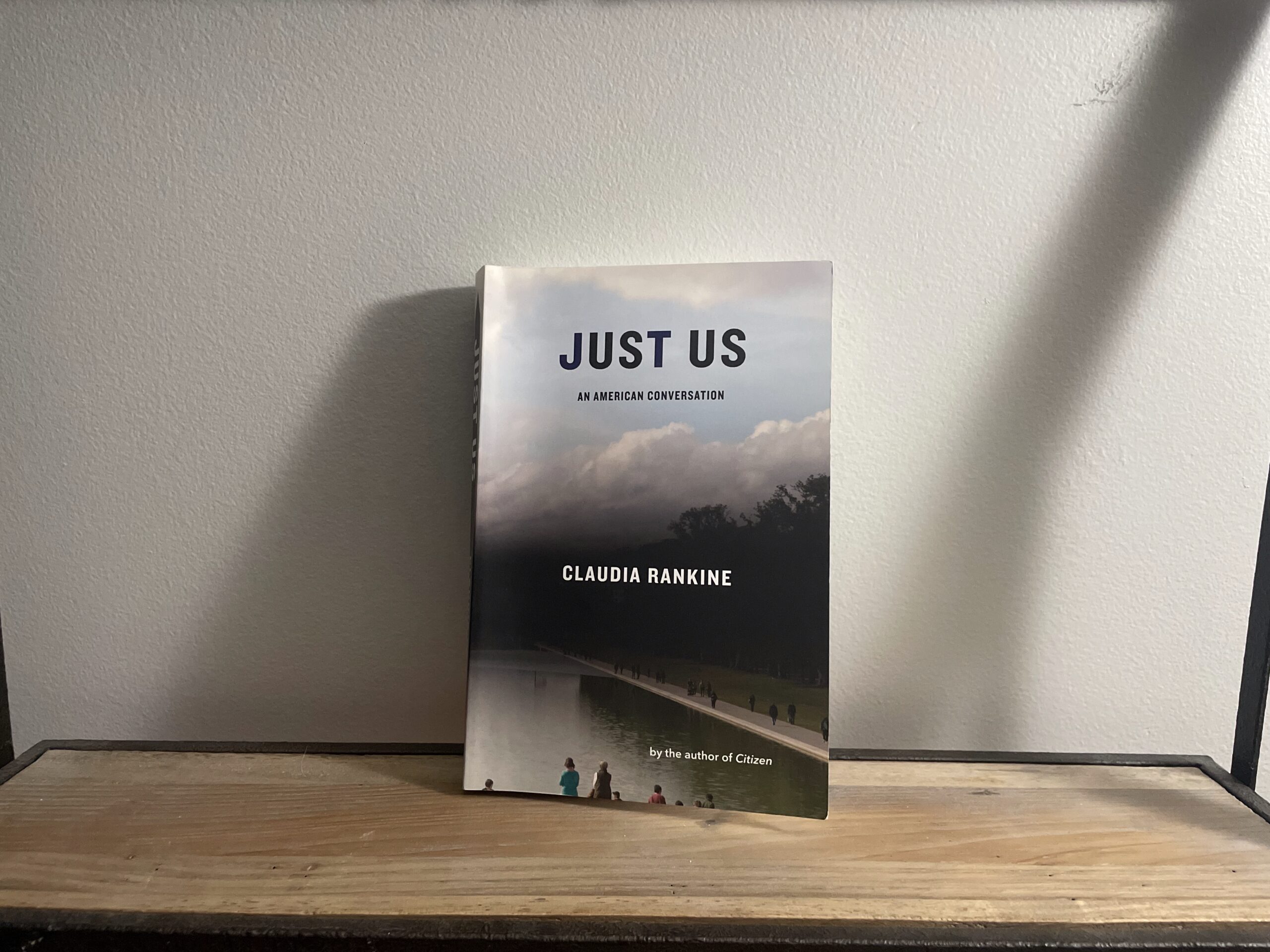
A gorgeous book. Glossy pages, combination of photos, poetry, lyric essay, screenshots, and research. A book that really expands the power of what poetry and lyric essay can be. A book by a writer who Bob and I both agree is operating on an entirely different intellectual plane than most of us. And yet, a book that, of the three of hers I have read, I found the most frustrating. Maybe challenging and implicating, too. I’m talking, of course, about Just Us by Claudia Rankine.
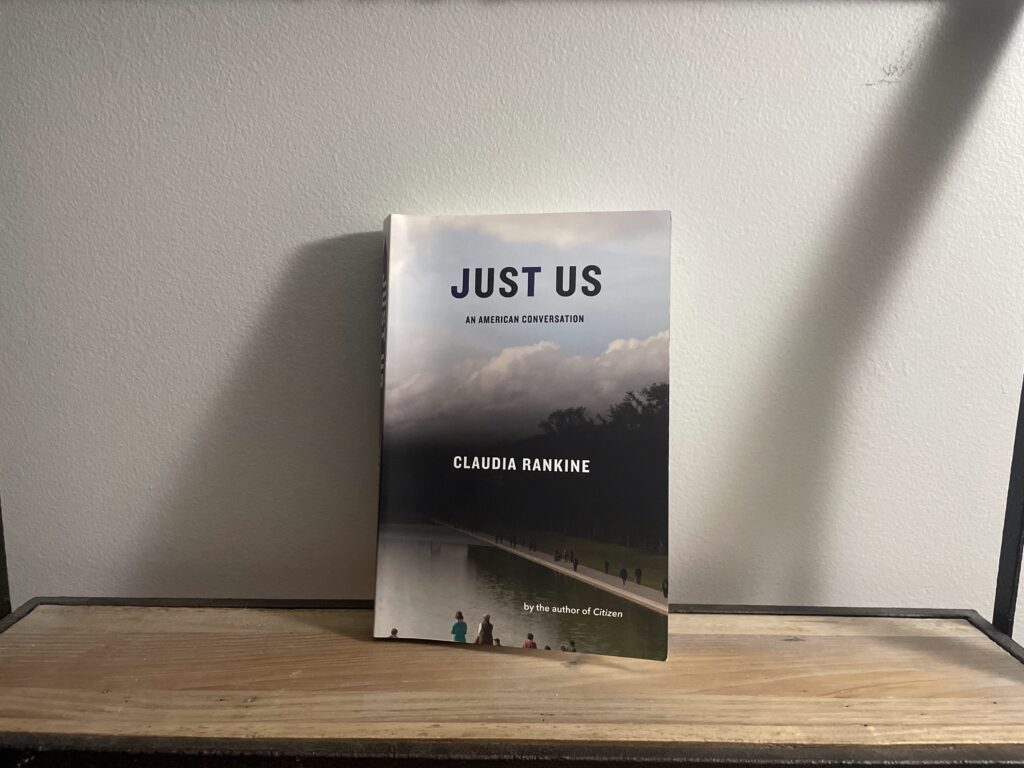
Just Us by Claudia Rankine: it’s hard to think of a writer I respect more than Claudia Rankine. She is thoughtful, innovative, she has a true artist’s spirit, she has ascended to the highest highs a poet/essayist can, and she has maintained artistic integrity while doing it. She meets the moment (like in Don’t Let Me Be Lonely) and sometimes even anticipates it (Citizen came out in 2014, after Trayvon Martin and Tamir Rice’s murders, but before Michael Brown’s murder kickstarted Black Lives Matter). Perhaps most of all, Claudia Rankine is patient. She will listen to people, turn thoughts over, remember conversations, and give people chances. The book is subtitled An American Conversation, and the Richard Pryor and Audre Lorde epigraphs point to the idea of just having a conversation. Crucially, this book was written before the United States elected Donald Trump president for a second time. Who’s in the mood for conversation? Reading in 2026, I found myself almost yelling at the pages. “WHY are you talking to business-class white men in airports about white privilege? They are not going to hear you!” Some of the interactions she has gave me the same impression I get from Evangelical pastors who stand next to people at urinals at ask if they’ve given their life to Jesus Christ. As The Dude tells Walter, “you’re not wrong…” I do think the ability to read the room is an important skill, though, and sometimes it feels like Rankine is causing herself anguish by (often rightfully, I might add) expecting the people she’s talking to to be on the same page as her. At one point, in marriage counseling, it comes out that Rankine had told her husband to go ahead and ditch her while she goes through the cancer battle, because he is a handsome and financially stable white man and he can have anything he wants. She is initially unable to understand that this would be a hurtful thing to say to a devoted partner.
There is reflection, though, and maybe what I should really applaud is Rankine’s willingness to put all of herself on the page. “If many white men can have what they want, including potential anonymous women of any age they have yet to meet, in a society set up to support them with images of officers and gentlemen and Don Draper, that does not mean, the counselor implied, my husband wouldn’t be devastated by my absence,” she concedes. There’s a lengthy essay, broken into multiple sections, where Rankine does have a conversation with two different friends, giving the others space on the page. It’s a stretch of brave honesty and real learning from all three, and is moving to read. Again, I’m not saying Claudia Rankine is wrong for expecting better of both strangers and her friends. James Baldwin rings in my head: “how much more time do you want for your progress?” It just sometimes felt like misplaced energy, at the expense of peace of mind.
Reading this after reading Assata was somewhat whiplash-inducing. An on-the-ground fighter in the streets of New York, followed by a Yale professor doing a different kind of on-the-ground fighting (talking to know-it-all-Ivy-League profs and businessmen in airports1). Reading a lot of anarchist thought lately, plus the people at the top totally deciding not to fascism, plus my actually being on the ground defending my neighborhood from ICE/CBP/DHS, has made me really indifferent to the hearts and minds of the elites. To me, the Ivy League is not the hallowed halls of learning that it bills itself as, but a place for comfortable people to get rich off of scolding less comfortable people. The Ivy League arrests people for protesting genocide, the Ivy League capitulates to Donald Trump, the Ivy League cozies up to Jeffrey Epstein and his weird ideas about eugenics. Now, I know that the truth lies somewhere in the middle. Incredible research is happening in the Ivies, good work is happening there in multiple fields, and for a while? The Ivies were hiring geniuses like Claudia Rankine. The opposing forces of ‘genuine learning’ and ‘the desires of imperialism’ seem to be coming to a head in 2026, though. I’m not saying Claudia Rankine needs to quit Yale and start a podcast or something, but I do think our best and brightest need to consider whether or not those supposedly hallowed halls are where their energies belong anymore.
LINKS!
Something to listen to while you browse? While all the focus on Pure Hell Wednesday was fun, many people on Bluesky pointed out that Death was another contemporaneous Black punk band. My biggest takeaway is that all the good band names are taken. Death and Pure Hell? Damn, now I’m convinced we’re in a cultural decline. Wasn’t convinced of it before, thought it was something lazy people said, but band names peaked in the 1970s. With Pure Hell and Death. Anyway, here’s a KUTX set Death did in 2013. Old dudes still got it.
- This week in ICE (plus a few I just now got around to): Letter From Minnesota: “Normalcy is Impossible Here. Normalcy is Violence.” by Michael Kleber-Diggs in Lit Hub, ICE moves out to the suburbs by Gaby Del Valle in The Verge, Woman sought after setting fire to Kansas City, MO, warehouse once considered for use as ICE detention center by KSHB 41 News Staff (if you see this lady, no you didn’t), Language matters: Abolish ICE vs. Abolish “Trump’s ICE” by Morgan Elise Johnson in The Triibe, Immigration Judge Fast-Tracks Asylum Hearings For Local Somali Asylum-Seekers by Francia Garcia Hernandez in Block Club, “Reforms” Didn’t End Police Violence in 2020 and They Won’t End ICE Violence Now by Lydia Pelot-Hobbs and Living Under a Concentration Camp Regime — and Fighting Back by Kelly M. Hayes and Andrea Pitzer in Truthout, Eileen Gu Will Never Be The Traitor JD Vance Wants Her To Be by Patrick Reford in Defector (yes, I believe it connects to the project of ICE)
- It gets its own designation because my anarchism-curious nature is only growing as it becomes clearer and clearer that Democrats have no interest in abolishing ICE or holding anyone accountable: Minneapolis Shows Us Anarchism at Work by Emma Arcadia in Assigned
- Let’s read some poems. Here’s “On Building An Assignment At Birth” by Maya Williams in Estrella House Publishing
- Here’s “Bathtub” by Daniel Miller in Burial Magazine
- Jesse Jackson died this week. In my upper middle class child-of-the-1990s, parents-watched-Jay-Leno brain, Jesse Jackson was something of a punchline. In recent years, I’ve learned how wrong I was, and how much this country will beat your reputation down if you’re a successful leftist. Jesse Jackson was the leader of a multiracial leftist coalition that had real Presidential ambitions. He believed in things like universal healthcare, reversing Reagan-era tax cuts for the rich, slashing the military budget, reviving the WPA to give people jobs and keep infrastructure strong, declaring Apartheid South Africa a rogue state, and supporting the formation of a Palestinian state. Naturally, the DNC ran him out of town, and then lost 49 states in the 1984 election. On Bluesky, Jerry Boyle said of Jesse Jackson: “I was always relieved to see him. With cops he was like garlic to vampires. It was a safe bet they wouldn’t make any trouble while he was there. A human shield, protecting us all.” Here’s Rev. Jesse Jackson left a lasting impact on civil rights and political possibilities for Black America and Jesse Jackson’s legacy paved the way for Kamala Harris’s historic Democratic nomination by Tonia Hill in The Triibe.
What’re you still doing here? Need another Black punk band? I’ve really been enjoying Big Joanie, both of their albums are great. A 2010s punk band!
If you work in the service industry, may you clean up in tips this weekend. I am certain that you can read a room a little better than Claudia Rankine—that skill is a survival mechanism in service jobs. I do hope, however, that you are as demanding of basic decency and awareness as Claudia Rankine is. You, the service worker, you deserve better than the way you’re being treated.
Sorry you got an email,
Chris
- frankly, I’m less afraid of the former kind of fighting ↩︎