“They were like zebras, he thought—not one had stripes just like any other, but who could tell one zebra from another? He found it depressing, not that lynching could be anything but. However, the crime, the practice, the religion of it, was becoming more pernicious as he real that the similarity of their deaths had caused these men and women to be at once erased and coalesced like one piece, like one body.” – Percival Everett, ‘The Trees’
It’s been a while since I’ve done a “Top Five Authors” ranking for myself. Periodically checking on my top fives of whatever is a fun exercise—what am I really into lately? Aimee Bender and Gabriel García Márquez have the top two spots, that’s a given. Who are the other three? Well, Percival Everett’s definitely one. I’ve been holding off on saying so because of how little of his output I’ve read. Guy has over 30 dang books and I’ve read six, counting next week’s book. This week was a re-read, too! Still, the way his books make me feel, make me think. Nothing quite like it.
Hey, forgot to mention new Lazy & Entitled Podcast last week! Have you ever wondered what Chicagoans think about things? All year, we’ve been asking our Chicago-adjacent guests a series of questions about the city. For this round, we’ve got answers from Bridget Gordon, Kelly Dwyer, H Kapp-Klote, Kathleen Rooney, and Logan Trent.
Apple | Spotify | SoundCloud
What I’ve Been Reading This Week
A re-read, obviously. My second-favorite novel ever? Maybe. It held up on re-read. I heard this book described recently as “literary fiction that reads like a literary thriller,” and that feels right. It’s a book that’s really careful about its words, because there are so few of them for how much story happens. It’s a book that treats magic with respect. It’s one of the funniest books I’ve ever read, even if it is about lynching, which—read the epigraph to this blog, yknow? It’s hard to say much without just gushing, so let’s get to it. I’m talking, of course, about The Trees by Percival Everett.
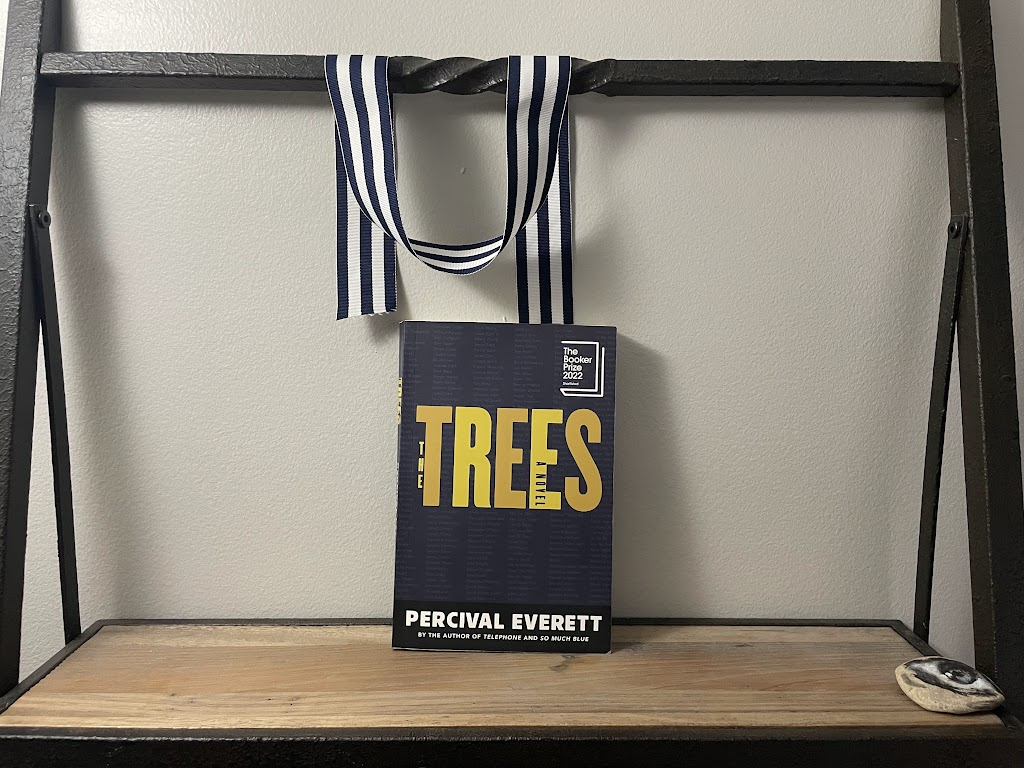
The Trees by Percival Everett: let’s make like Marvin Gaye and do a quick What’s Going On. In maybe the greatest chapter one in all of literature, we meet a “lovable” family of fuckup crackers in Mississippi—a man whose only ever job was a truck driver, which he got fired from for driving the truck half off a bridge while drunk. A woman whose children call her Hot Mama Yeller because that’s the CB handle she uses to talk to the truckers with whom she cheats on her husband. A few cousins. Dogs, pigs. And the matriarch of the family, the woman who claimed that Emmett Till catcalled her. Before long, bunch of white supremacists start turning up dead. Well, mutilated. As if they’d been lynched. And there’s a body of a Black man with the victims, but that body has been embalmed and looks suspiciously like Emmett Till. Our main characters are two Black agents from the Mississippi Bureau of Investigation. On their way to unraveling everything that’s happening in Mississippi, copycat “crimes” start popping up in California. Illinois. The rest of the South. Wyoming. Except not every crime scene has a Black body—sometimes there are Asian bodies, Indigenous American bodies.
It’s retribution for lynching, coming from all corners. It’s retribution for white supremacy in North America. Is it magic? Is there some shadowy group behind it all? Does it matter? But lemme back up, I wanna talk writer’s toolbox stuff. Almost every chapter is two pages, and the novel is very dialogue-heavy. Actions are sometimes revealed through dialogue. Some actions are left for the readers’ imagination. Yet it still feels careful with its language. Every piece of information is important. Even when a chapter is a list of names, you can’t skip over the names. The text won’t let you. Another effect of such short chapters is how it highlights that there’s no poetry to the ugly history of lynching in the U.S. It was practically a religion. There’s no poem there. There’s very little to say. There’s very little reason to expect things to change—pay attention to how Lulabelle (the eldest child) starts turning into Hot Mama Yeller, pay attention to Red Jetty’s conversation with his wife the one time we see her. Then ask yourself how you’d answer the question at the end of the book.
Just like that, we’re back to retribution. Obviously, I’m not gonna get on here arguing for race-based violence. I am a non-violent person. This novel ends with a provocative, difficult-to-answer question. Sort of like The Golem Of Brooklyn. Unlike The Golem Of Brooklyn, this novel doesn’t have the specter of, say, Haiti doing a pro-active genocide against Mississippians. In fact, Haiti has been the victim of state-sanctioned racial violence from the Dominican Republic, economic violence from most European countries, and, of course, virulent racism from the current sitting president and vice president of the United States. So yeah, this book has a great ending with a tough question. If you’re making course syllabi, consider putting The Trees and The Golem Of Brooklyn together.
LINKS!
Something to listen to while you browse? Hey, funk isn’t normally my thing, but sometimes YouTube will serve up an enticing video. I’m glad I watched this one. It’s acoustic! Check out The Psycodelics.
- Hey cool, it’s my neighborhood: A Community Organizer’s Guide to West Ridge by Camilla Forte in Borderless Mag
- Ask an Expert: What Makes Chicago a Union Town? by Ellie Gilbert-Bair in South Side Weekly
- Meant to link this way earlier in the way, but it’s not like it’s gone out of style. How Can We Live Together? by Olúfẹ́mi O. Táíwò in Boston Review
- Really like this perspective on the job of a historian: The Hardest Part Of History To Tell Is How It Felt by Craig Fehrman in Defector. A pull quote, because Defector is subscription-based (but worth it!): “Historians and nonfiction authors often glide over lived experience. They prefer actions, citations, details, dates. But I had just gone through something primal—something beyond my control and beyond the boundaries of modern life. Gliding no longer felt honest or accurate. I thought I needed to dig deeper, to consider the intensity, the uncertainty, and the violence that defined the expedition.“
- Marge Schott Was A Five-Tool Bigot Who Would Have Thrived In Any Era by Tom Ley in Defector
What’re you still doing here? Wanna watch the “Cult Of Personality” video? Sure you do. When was the last time?
If you work in the service industry, may you clean up in tips this weekend. As with the first time I read The Trees, I was struck by Everett’s decision to have two Black cops and a Black FBI agent be central characters. One thing he does is constantly have them say stuff like “yeah, we’re cops, and we don’t like it either. But we don’t like the idea of Whitey having all the guns and authority.” So carry Jim & Ed’s seriousness about but casual disdain for work to your job this weekend. Someone’s gotta do the work; being happy about it was never a requirement.
Sorry you got an email,
Chris