“& was there a knock again at the wall? / In point of fact, there came a child / on a path from without— / a stuffed moose under her arm” – Joshua Marie Wilkinson, ‘Bad Woods’
What up my dudes, I still have a not-even-two-month-old baby. You know what else is happening? We got an opening day for Little Wild! If you’ve missed it, Little Wild is an extension of Rivers & Roads Café. Yes, the same café Brendan works at, and where we’ve been having our poetry readings. We’re opening our doors on November 28th! Aka Small Business Saturday. Follow us on Instagram if it helps you remember. Come see us, grab a coffee from Rivers & Roads and a book from Little Wild. I’m the guy ordering the books, so if you like this blog, you know.
Hey, speaking of books I read—
What I’ve Been Reading This Week
Five full poetry collections, my dudes, it is a celebration week. We are seeing an ambitious, wildly inventive, highly personal yet alluringly strange project wrap up. A pentalogy of poetry collections, told in long lyrics, set in bustling yet lonely nightmarescape where it’s always raining and the only light is an annihilating moon or cautious lanterns making moths dust. Down these strange streets bordered by bad woods walks the meadow slasher and rides the courier. I’m talking, of course, about Selenography, Swamp Isthmus, The Courier’s Archive & Hymnal, Meadow Slasher, and Bad Woods, aka the No Volta pentalogy by Joshua Marie Wilkinson.
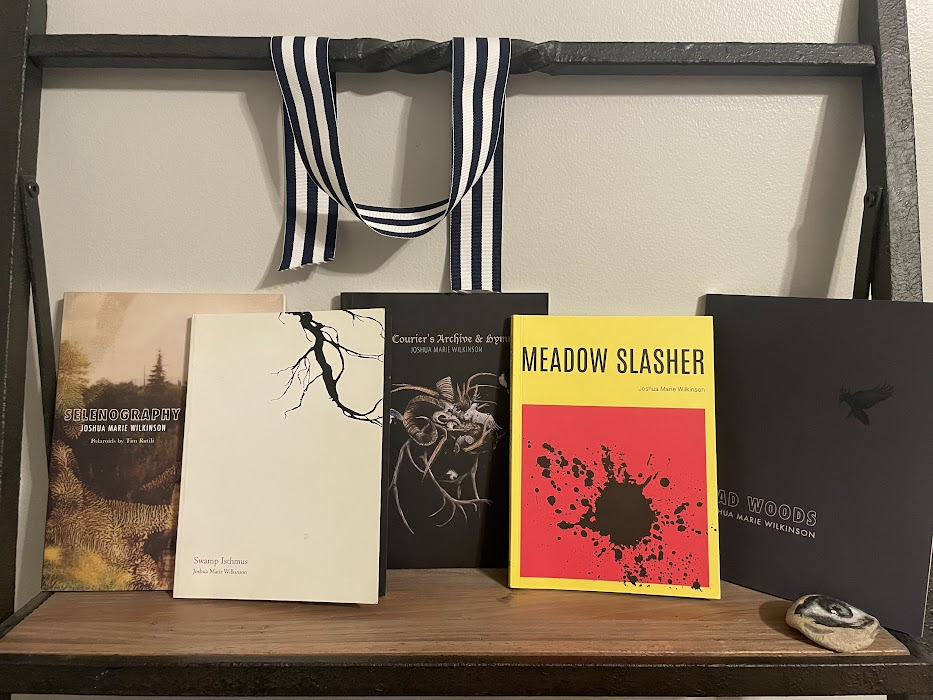
Selenography: the title means mapping the moon, and I think titles are instructive. The poems are written in response to Polaroids taken by Califone’s Tim Rutili, and they inform each other as well. Don’t think that there’s any promise of communication, here, though. The Polaroids are tastefully smudged, and if memory serves, Josh was thumbing through a shoebox full of the photos at Tim’s house. “Hey can I use these for my book” “sure.” Don’t take my word as gospel unless you remember that the gospels are also questionable sources written decades after the fact, and don’t come to these poems expecting something as corporate slogan ready as two paths diverting in the woods. But there will be woods. You don’t want the woods, but there will be woods.
Swamp Isthmus: I should have said already, you are doing yourself the greatest disservice if you dont read Josh poems out loud. A friend recently asked me how I read poetry. I don’t really have a good answer—that’s why The Line Break exists—but go cover to cover and read out loud as much as you can. Swamp Isthmus might be the one of these five that benefits the most—like Selenography, these are multi-page long fragmented lyrics. Unlike Selenography, we’re dispensing with punctuation and letting the words paint splatter over the white space. Reading these books back to back is a way to see how repeated images start to circle around meaning. The poems themselves pick things up and drop them in the span of a few lines—you might think “these things don’t mean anything together”—but as I tell my guitar students about soloing, repetition legitimizes. Repetition makes things sticky while complicating initial perception. Kinda like a swamp.
The Courier’s Archive and Hymnal: it’s possible the speaker is the same throughout the pentalogy, it’s possible that there are multiple characters. The influence of The Battlefield Where The Moon Says I Love You ghosts over these five books, but there are overt characters like Jimmy or whomever. This book is written like the journal of a bike messenger, prose fragments knifing through a city.
Meadow Slasher: the breakdown. Our speaker’s in a bad way, there’s no way around it, no metaphor to tuck away emotion, no mystery about which parts of Andersonville we’re crying in or stumble-drunk in. The speaker is chiding himself as “the master of bloodless experiment / of cottoncandy surrealism & the so-called new brutalism. / Of battletide & conceptual genuflecting,” and whether or not that’s entirely true is immaterial. There is a shift to a bit more communication in this book than the previous three. Yet we’re still in the strange world of couriers and swamps across the Cumberland Gap. Formally, this is one long lyric, made of what I’ve seen Josh describe as “broken sonnets.” 11 lines, no volta. Hey, title of the pentalogy. It, combined with Josh’s unmatched musicality, makes for mesmerizing reading. Mental breakdowns and fantasies of self harm aside.
Bad Woods: is good. You can understand why it took 16 years to wrap up the pentalogy—a lot changes—yet Bad Woods still unmistakably belongs with Selenography and everything in between. Part of that is repeated images and recurring characters, part of that is style. There’s still a world here, though. Even if some of the places have been situated in the real world—Chicago, Athens, various outposts of Tennessee—the specific nightmarescape of the No Volta pentalogy remains singular. Syllabus this with Frank Stanford’s Arkansas in Battlefield. I can’t recommend these books enough.
LINKS!
Something to listen to while you browse? Remember that Lissie performance on Twin Peaks??!
- The Catapult Books Sale & the Age of Damnation for American Publishing by Michael Welch in Chicago Review Of Books
- Sloane Murphy Is The Bard Of Chicago’s Drunk Trans Women by Lauren Thiesen in Defector
- Daniel Janzen and the long work of bringing back a forest by Rhett Ayers Butler in Mongabay
- New Data Centers in the US Set to Wipe Out 15 Years of Greenhouse Gas Reductions by Joe Wilkins in Futurism
- Making A Great Fantasy Map Is An Art, And Ross Douthat Sucks At It by Albert Burneko in Defector
What’re you still doing here? Did we listen to “Easy” by Okonski yet? I don’t have a short-term memory right now, it’s constative fact. Who cares, we’re going to again.
If you work in the service industry, may you clean up in tips this weekend. Don’t go into those woods, young courier. You should say no scary.
Sorry you got an email,
Chris