
“The map had been the first form of misdirection, for what was a map but a way of emphasizing some things and making other things invisible?” – Jeff VanderMeer, ‘Annihilation’
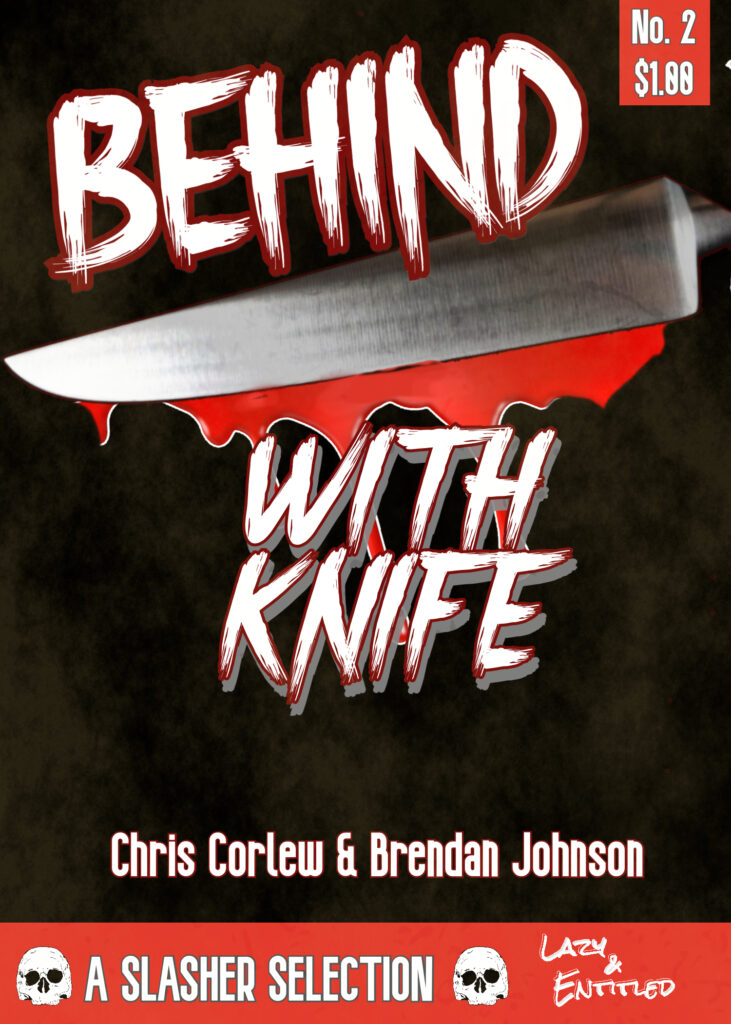
IT’S OCTOBER! I’ve been so looking forward to this October. First of all, we got Behind With Knife happening. Go read Behind With Knife! Chapters 1-5 up now. If this were a physical book, you’d be finishing “Part One” as you read today’s chapter. No new chapters Saturday and Sunday, then Chapter 6 on Monday. The last chapter—Chapter 25—goes out on Halloween.
Now. On to the other reason I’m excited it’s October: there’s a Lazy & Entitled reading on Wednesday! We got Lauren Bolger, author of the new book The Barre Incidents, and Theodore C. Van Alst, Jr., author of the new book The El and co-editor of the anthology Never Whistle At Night. Come out to Rivers & Roads Café and let’s have a spooky time.

Now. On to the other other reason I’m excited for October.
What I’ve Been Reading This Week:
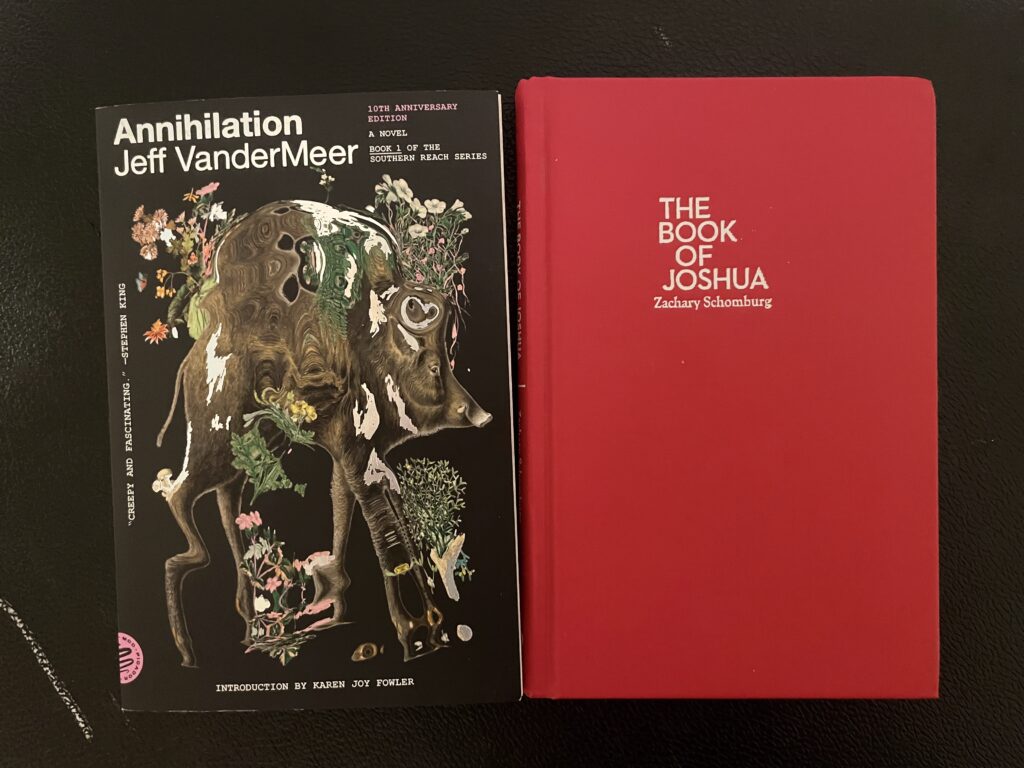
A book that got really hyped for me, then had a puncture right as I started it. It worked out—the excitement spell was off, I was immune to hypnosis, and I still ended up loving it. A book that I was told would make me hate its movie adaptation. Sort of—I still love the movie, but let it be known that it’s flat-out not an adaptation of the book. A book that begins the fourth series we’ve read in a calendar year on the Shipwrecked Sailor blog (Indian Lake Trilogy in October 24, five-book Hitchhiker’s Guide Trilogy in January, Broken Earth Trilogy in February). That’s right, October is Southern Reach Trilogy month. As a companion piece to Annihilation by Jeff VanderMeer, I re-read one of my favorite books of poetry, the closest book I can think of to describe as “sci-fi horror,” The Book Of Joshua by Zachary Schomburg.
Annihilation by Jeff VanderMeer: what a fascinating object. I’m reading the luminously-covered 10th anniversary edition, which seemingly every Big Deal Writer has fallen all over themselves to praise. This series is wildly influential, the novel got a Big Deal Hollywood adaptation right after publication. Yet the first book is pretty slim, very strange, and unsettling to the point where I actually warned my wife one day that I was feeling off and uneasy and please forgive any weirdness. An expedition of four women named only by their professions— biologist, anthropologist, linguist, and psychologist—venture into a strange bit of land known as Area X. The movie makes pretty explicit that Area X is the result of alien invasion; the novel is ambiguous. Point is, no one from any of the expeditions into Area X has ever come back alive. The seaside community that used to be there before Whatever Happened To Create Area X is gone. It is a “pristine wilderness,” yet something is seriously off. There’s a tunnel that our narrator, the biologist, insists on referring to as “the Tower.” There’s a lighthouse hiding a horrifying secret. There are animals that seem, for some inexplicable but undeniable reason, to have been human before.
What happens to each character is very different from the movie, but rest assured that ain’t none of it good. Now: do we care about these nameless characters? A criticism I heard is that the prose is deeply alienating, and I don’t disagree. The third person narrator would be Natalie Portman’s character in the movie, and Portman nailed the brusque unsentimentality of the biologist. This is not just someone who’s bad at parties, this is someone who needs to be left alone near a pond or forest, for the well-being of her and everyone else. Still—and maybe this is the nature poet in me, or maybe it’s because I had been warned about the coldness of the prose—I ended up loving this novel. If it were any longer, I might feel differently. Then again, I was left wanting more. The biologist deliberately leaves things unsaid, which is both for the reader’s supposed benefit and a great trick.
That’s a good way to pivot into the cosmic horror of it all. There are the obvious images: animals that maybe used to be people, the strange and hyper-natural landscape, people who clearly aren’t themselves, microbes writing words on walls. The implication of horror, though, is what really sticks with you. When the biologist uncovers a secret, contemplates what she’s gazing at, and then demands the reader (this is presented as her journal to the Southern Reach) also contemplate? Whew, it sticks. Something about that extra step—coupled with the image—is really affecting.
The Book Of Joshua by Zachary Schomburg: I won’t call Zach a cosmic horror poet, but the guy does “looming sense of dread” better than almost anyone. I’ve read this book twice before, and each time, it makes me want to write. This time around, my wild inspiration thought was “what if I wrote a Book Of Joshua for all of my narrators?” It’s that kind of book. There’s a trip to Mars, a river of blood, and a son getting pregnant with/giving birth to his own father. Zach’s no stranger to surrealism, but his books usually make me think of James Tate (complimentary). This one makes me think of Aase Berg (complimentary). It’s a perfect companion to Annihilation, for anyone out there making syllabuses. I think I’ll read a Zach book every October for the rest of my life.
LINKS!
Something to listen to while you browse? Let’s not be complicated. I love this video from my second-favorite band, and the vibes are right for spooky season (two scary minor key songs bookending a major key second song, reminding us how October is now just an extension of summer. I’m still grilling dinners).
- Can’t believe I haven’t shared this, I thought I did. Here’s my beloved Bob Sykora interviewed by the homie Danny Elfanbaum in Vol. 1 Brooklyn
- ChatGPT advises women to ask for lower salaries by Siôn Geschwindt in The Next Web
- The Suburban Drug War by Matthew D. Lassiter in Inquest
- Excellent, excellent reminder from Lincoln Michel on his blog Counter Craft: style is more than sentences
- I’ve talked before about loving David Roth’s Defector columns, and feeling bad that he usually has to write shit like Men On The Verge Of A Nervous Breakdown or The United States Of Snitches, when all he really wants is to write about Ron Karkovic’s mustache. So here’s How To Go To A Mets Game. It’s hard to find a pull quote for one of the better articles about sports fandom I’ve ever read (apply this whole article to any Chicago sports team and it works), but here’s a pull quote, because Defector is subscription-based (but worth it!): “These sorts of communal Mets game experiences, which I treasure, are easier to have in lost seasons, when the secondary market for tickets collapses and it becomes easier to convince friends to come out to watch a game they don’t really care about. When the stakes are lowest, the ticket price is more or less a cover fee for admission to a severely overpriced beer garden at which your friends and their children are also hanging out, and where there is a much higher chance of seeing Mr. Met than at the average beer garden.“
What’re you still doing here? Go read BEHIND WITH KNIFE!
If you work in the service industry, may you clean up in tips this weekend. Hey, if you see any microbes using a multitude of their own tiny bodies to scrawl words about sinners on a wall, don’t touch it. You know, there are places on Earth we shouldn’t go. Back on Twitter, I used to follow a Filipino cartographer (David? Was his name? Unsettling how easy it is for someone to fade when you only know them through social media). He talked about Indigenous groups telling him there were areas where he couldn’t map. You have to respect where you can’t go. A little show called Twin Peaks understood this. Hell, Brendan and I made it a big part of Vine, and I hadn’t even seen Twin Peaks when we wrote that. Good thing there’s always a Roadhouse, or a Gentleman Jim’s, or, if you’re reading Behind With Knife, a Jimmy’s Pub. Aw hell, this part is supposed to be for the workers. Find the places you are welcome, and do not worry about where you are not.
Sorry you got an email,
Chris