“At night, mother smudges our foreheads with ginger and steam. Her song is a braid of witches who lift windows with a single, crooked finger to slip inside and feed.” – Rachel Cruz, “What We Did With The Aswang”
It’s officially October! Welcome to scary month! Welcome to Hell! Even though October has the second-best weather and vibes of any month of the year. Watch some Brandon Cronenberg, watch some Nia DeCosta, watch some John Carpenter, watch some Wes Craven, watch some Jordan Peele, watch Sinners if you somehow missed it. Get scared, have a blast.
What I’ve Been Reading This Week
A novel and a book of poems that ended up pairing well together, without me doing that intentionally. Love when that happens. Two books influenced by island living—no, not Margaritaville or Punta Cana—more like, the way living on an island forces you to understand both the ocean and colonialism all too well. Two books that problematize the concept of “what IS a monster, dude?” in ways that, I’m just gonna say it, Guillermo Del Toro could only dream of. I’m talking, of course, about Weird Fishes by Rae Mariz and God’s Will For Monsters by Rachel Cruz.
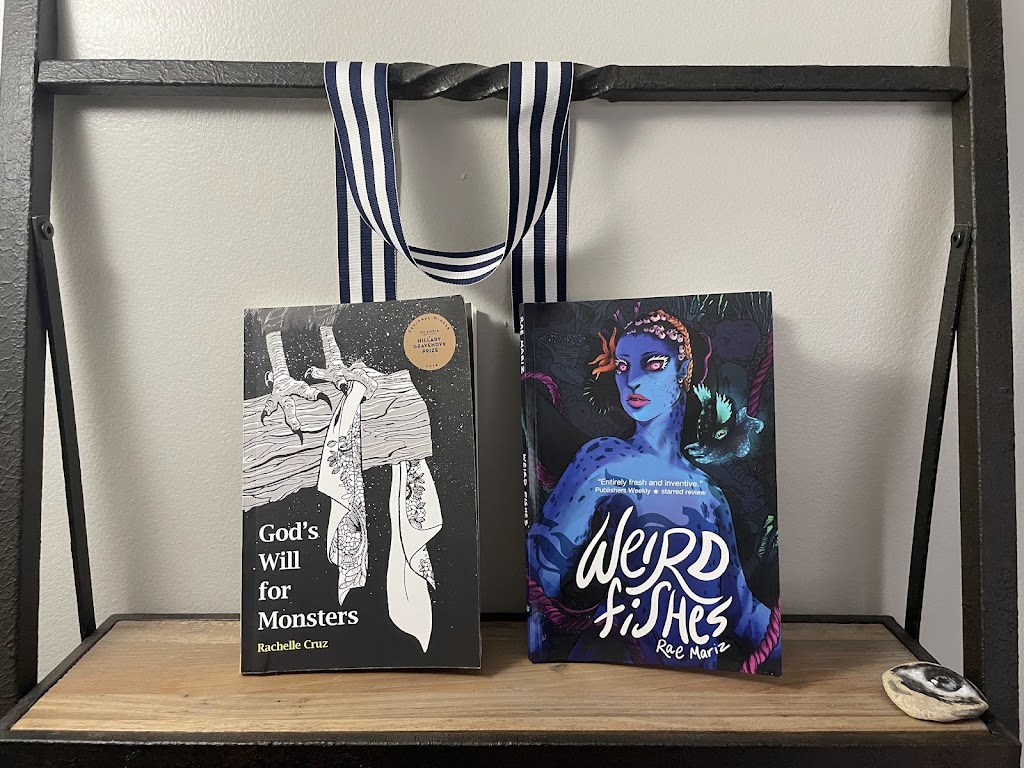
Weird Fishes by Rae Mariz: hang with me on the setup here, because there aren’t really any human characters in this book. I’ll confess to, having read this book in the mad dash of getting ready for my daughter’s arrival, I didn’t sit with the imagery as carefully as I could have. So picturing what Ceph, a squid-like ocean floor-dweller, looks like, was difficult. Iliokai, our other main character, is a whale-rider—what you or I might call a mermaid or selkie. Interestingly, “whale rider” is established as a slur, or at least a less-than-preferred term, but the text continuously refers to Iliokai as such. It recalls how Indigenous Americans will call themselves “Indians,” but I don’t really feel comfortable doing so as a white person. Real-world allegories continue, because when the bottom-dwelling Ancient Intelligence gains awareness of the human-driven climate apocalypse, their solution is to open deep sea vents that will boil the ocean. All life on Earth will disappear except for them, and what do they care about the rest of life on Earth? It’s up to Ceph and Iliokai to stop the apocalypse.
It’s an unlikely friendship story that features some nice “the world is bigger than you previously imagined” moments for Ceph. After some delightful “quest for knowledge” stuff, some fish-out-of-(well not quite)-water hijinks, the story then effortlessly shifts into a “and that world is going to end” story. Once our friends meet and figure each other out, the quest is waiting for them right away. I really appreciated the way the botton-dwelling cephalopods—who refer to themselves as the Ancient Intelligence—are basically as ignorant and arrogant as humans, they just happen to dwell at the bottom of the ocean. Sometimes a to-the-point 1:1 metaphor is just what you need. The ending is exciting. I won’t spoil anything, but some Hawaiian mythology comes into play. It might be tempting to call the ending a deus ex machina, but I think the ending builds on themes already established in the rest of the novel. The world is bigger than you think, and sometimes you can’t control what happens. Then the last chapter is kinda like B roll over end credits, which is fun.
God’s Will For Monsters by Rachel Cruz: ooooh baby, this is monster poetry. Well. It’s a lot of things—family poems, Filipino diaspora poems, coming of age poems, womanhood poems, postcolonial poems. They’re tightly constructed prose blocks or just-right enjambed lyrics, imagistic and specific. A standout long poem is “MAXIMUM 25 WORDS,” which is almost entirely made up of remittance forms for money sent from the U.S. to the Philippines. But monsters organize the book: there are addresses to Aswangs (a Filipino legend that rips itself in half and licks unborn babies out of mothers’ wombs). The section breaks are erasures of encyclopedia-like entries on vampira, weredogs, manananggal, carrion-eating ghouls, and witches. The poems interrogate monstrousness as a way of othering people, and also use monstrousness as a way of reclaiming agency/power. But also, there are lot of blood and guts. This book absolutely goes in my October poetry rotation.
LINKS!
Something to listen to while you browse? Hey, Rae brought up this comparison in the acknowledgments page, not me.
- What Do Booksellers Make Of “The End Of Reading”? by Joel Pinckney in Defector
- Prose To The People by Katie Mitchell from the BLK LIT podcast
- The LIT Bar — A Hybrid Bookstore & Wine Bar in The Bronx from the BLK LIT podcast
- Our Favorite Bookstores In Chicago from Chicago Review Of Books
- Old news, but new to me, and really depressing to learn about Curbside Splendor in this feature from Taylor Moore in Lit Hub
What’re you still doing here? Here’s a weird not-fish.
If you work in the service industry, may you clean up in tips this weekend. Remember that those who fancy themselves the most learned are often the most ignorant. Sometimes, they’ll try to destroy the world.
Sorry you got an email,
Chris