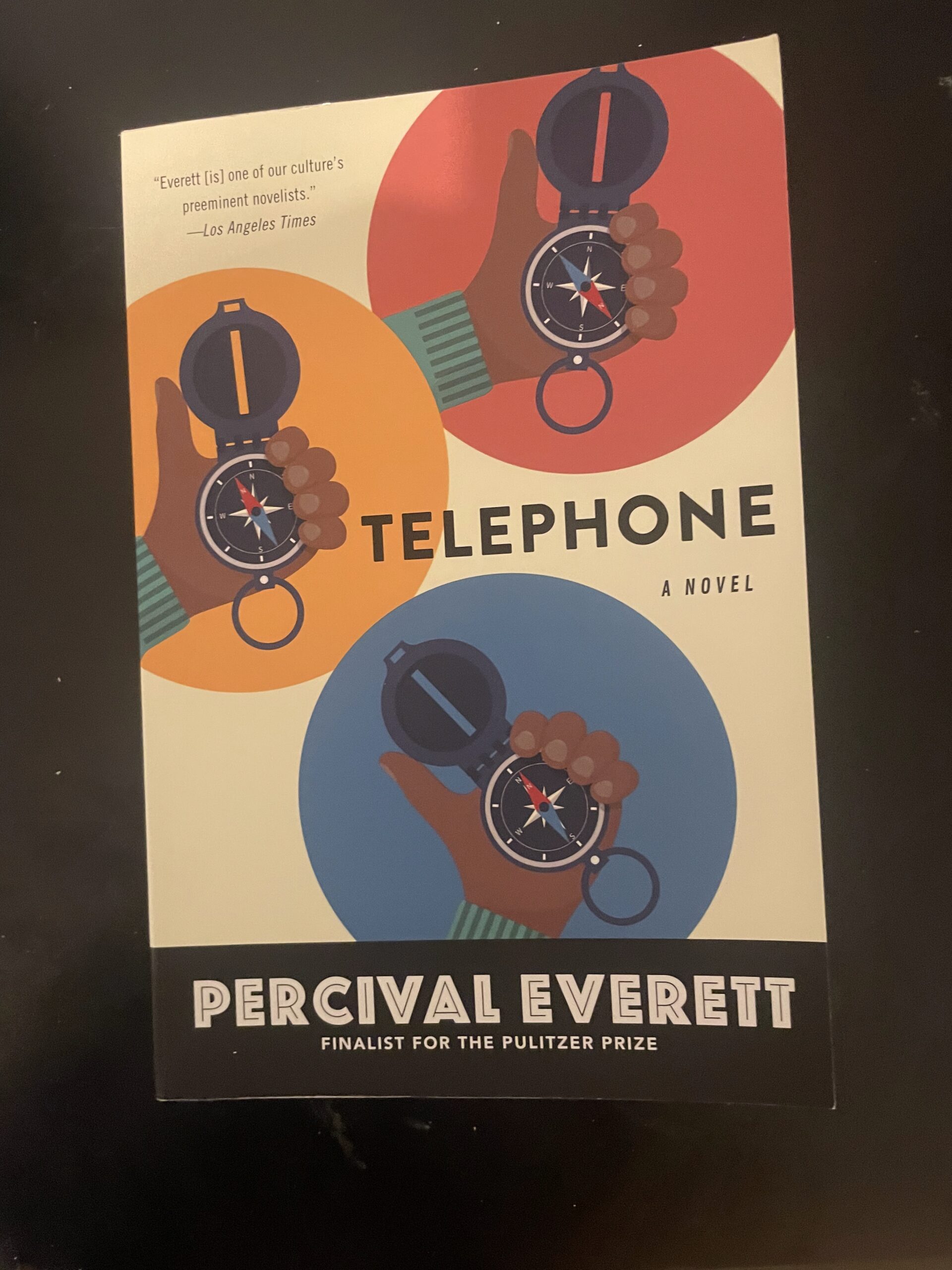
“At the moment of my utterance, I had been clear and certain about what I had wanted to communicate, but once I said it, I felt nothing but stinging regret.” – Percival Everett, ‘Telephone’
It is not always easy for me to tell why the great novels are the great novels. Like, why these, over others that I personally enjoyed more? Many times, I arrive at a cynical conclusion: some white liberals are sure gonna feel good about themselves, reading this. Or society decided this was a good one and everyone’s too scared to think for themselves. Not so with the book this week. This novel contained such a range of emotions, contained such a full plate of plot and realized characters and gorgeous writing—and I have no idea when I would have heard of it, had I not wandered to a certain table at AWP this past year. For most of my life, reading something like this would have me thinking “I’ll never be able to do something like that.” Whether that thought is true or not—”People, and by people I mean them, never look for truth, they look for satisfaction,” this week’s novel begins—it’s a completely unproductive thought. Maybe this writer is very gifted, but I when read this novel? I dreamed about what it would be like to write it.
Maybe that was an escape from dreaming about what it would be like to live it.
What I’ve Been Reading This Week:
A book that—let’s get some CWs out of the way up front—contains both terminal illness and suicide (separate patients). A book that made me think a lot about both. I want to encourage everyone not to commit suicide, to get help if you have the ideation. I’ve been there, you’re not alone. Also a book that made me go “goddamn right” about a thousand times, in regards to parenting. A book that presents certain visions of how to be a strong man, and a book that presents how strong men are often also weak, self-absorbed, and scared. A book, in short, with range. I’m talking, of course, about Telephone by Percival Everett.

Telephone by Percival Everett: an accidentally appropriate year-end book, expanding on a lot of what I have been thinking about this year. If the secret police come to your city and start kidnapping your neighbors, straight-up abducting, and your response is nonviolent intervention when you can, it’s hard to know how much you’ve actually accomplished. When your friend gets sick in a way that you can’t directly help with, but you can be a support, you can babysit the kids sometimes, it’s hard to know how much you’re actually doing. Yes, those two examples are explicit references to my life, but they are almost one-to-one comparisons of what the narrator of this novel has to deal with.
Our narrator is Zach Wells, an often-accidentally cranky paleogeologist with a distant but functional marriage and a 12-year-old daughter he adores. One day, after opening a jacket he got off of eBay, he finds a note pinned to the collar reading “AYUDAME.” Another purchase from the same seller—return address in New Mexico, a few hours from the El Paso/Cuidad Juarez terror zone—sees another note reading “they are not letting us go.” Oh, and his daughter gets diagnosed with Batten Syndrome. If you, like me, don’t know what that is, suffice to say that it’s an ugly, terminal, untreatable disease. If you, like me, have been trained on triumphant Hollywood movies where the hero’s journey completes itself in a satisfactory way? I am sorry, but you are reading a Percival Everett novel.
I am fond of saying, after reading 10% of his published works, that Everett writes the best endings in the business. This one is tough. “Unsatisfying” is a description I bet Percy would own up to, but just like The Trees, the ending is meant to redirect your thoughts. What you felt like the plot was is actually somewhat secondary to what the book is about. Even more than The Trees, this book withholds the conclusion you believe must happen. You reach the last page and are left wondering, “wait, what did I think was going to happen? Am I sure I wanted to see it? Will it matter to the narrator tomorrow?” What good is it, if we act? What good can one person do? What about one person and five people from a poetry workshop? What about one person and their estranged partner?
Zach has a refrain of not knowing what he’s doing. There’s a scene where he turns down speaking at a campus protest event not because he doesn’t believe in what the kids are protesting, but because he doesn’t believe his action will do anything. Any time he does act, it’s not that it goes wrong, it’s just abundantly clear that not only is he not a hero, but real life doesn’t care about heroism. So what do you do? Zach eventually does act, and we don’t see the results. Personally, I understand where Zach is coming from, but also? I see Zach as something of a hero1, both as a father and whatever he is in the second half of the book. If living in Chicago in the fall of 2025 has taught me anything, it’s to value the action more than the result.
LINKS!
Something to listen to while you browse? Reading Telephone has me thinking about being a parent. I also, this week, started Molly Lambert’s podcast Heidi World (yes, the feed is now called Jenna World, but I haven’t listened to what the feed is calling “season one,” and it seemed prudent to start with Heidi). That led to a mini-Wikipedia tour of 1960s and 70s perverted men/bad fathers, like John Phillips. I also have been listening to HI STANDARD a lot lately. It is highly likely that I’ve linked to their excellent cover of “California Dreamin” before, so here’s “Fighting Fist, Angry Soul.”
- Chicago Reader did its people issue last week, and it seems worthwhile to highlight a few of those pieces. Dominick Alesia, The Musical Fabulist by Kerry Reid; Nat Palmer, The Community Builder by Shawn Mulcahy; Janice Lim, The Replicator by Philip Montoro; Kate Palmer, The Full-Spectrum Doula by Jamie Ludwig; and Carlos Fernandez, The Movement Architect by Micco Caporale are a good starting five for that issue—go read the whole thing, tho!
- From The Triibe: Residents of South Shore building raided by ICE must move by Dec. 12 by Corli Jay
- From Block Club: How The Feds Used Propaganda To Frame Their ‘War’ On Chicago: ‘They’re Lying Constantly’
by Patrick Filbin and Mack Liederman, Logan Square Restaurant Raising Money For Family Of Employee Taken By ICE by Molly DeVore, Chicago Media Groups Voluntarily Drop Excessive Force Lawsuit Against Feds by Mina Bloom, ICE Takes Kurdish Asylum Seeker The Day Before His Wife Became A US Citizen: ‘I Cannot Do This Alone’ and Little Village Chamber Leader Thanked Border Patrol As Agents Arrested Neighbors, Video Shows
by Francia Garcia Hernandez,Immigrants Return To Little Village English Language Class After Federal Blitz Kept Them Away by Mack Liederman, Her Baby Was In The NICU. She Was In ICE Detention. (originally published in The 19th) by Mel Leonor Barclay and Shefali Luthra. Also in The 19th: Immigrating while queer: America has a complex history of exclusion by Katie Sosin - From South Side Weekly: Sentido Builds Space for Latino Joy and Survival by Jocelyn Martinez Rosales, Anatomía de un arresto a manos de la Patrulla Fronteriza by José Abonce, and Fraudsters target immigrants seeking legal help by Alma Campos and Max Blaisdell
- For our art break this week, it’s an old article—old enough to reference John Boyega as the star of Rebel Ridge, which, uh, changed—but I really, really enjoyed The Energy Can’t Last: On the Grimy American Fringes of Jeremy Saulnier by Roxana Hadadi in RogerEbert.com. I’ve only seen Green Room and Rebel Ridge. I’ve been wanting to watch more Saulnier. This article is making me do something about that soon.
What’re you still doing here? Don’t you know that Micah and Brendan have a show?
If you work in the service industry, may you clean up in tips this weekend. Hey, there’s a lot in Telephone about how Zach is gruff, cold, and insensitive, without meaning to be. I recognized a lot of Boomers in my life in Zach. This week’s book might be like a field guide for understanding some of your worst customers better. Maybe. Idk. What do I know.
Sorry you got an email,
Chris
- Zach is undisputedly a pretty bad husband, for the record, though I wouldn’t exactly classify Meg as the greatest wife, and it’s probably best to describe the marriage as “functional” and leave it at that. ↩︎