“Who were they / those men darkening // the barnmouth, / leaning like that” – Joe Wilkins, “Evening Elegy”
Goofy month for titles, it seems. Well, it will make sense when you realize that, in addition to a nonfiction book about filmmaking, I read two books of poetry from River River Books.
Man, I would hate to be without a river. Anyway, I’m going long on the books, so let’s get into it!
Not before promoting this month’s The Line Break, of course! I read from one of these books. Apple | Spotify
Also, don’t forget to check out Brendan’s new horror movie recommendation column, Notes From The Nothingness, right here on this very website!
What I’ve Been Reading This Week:
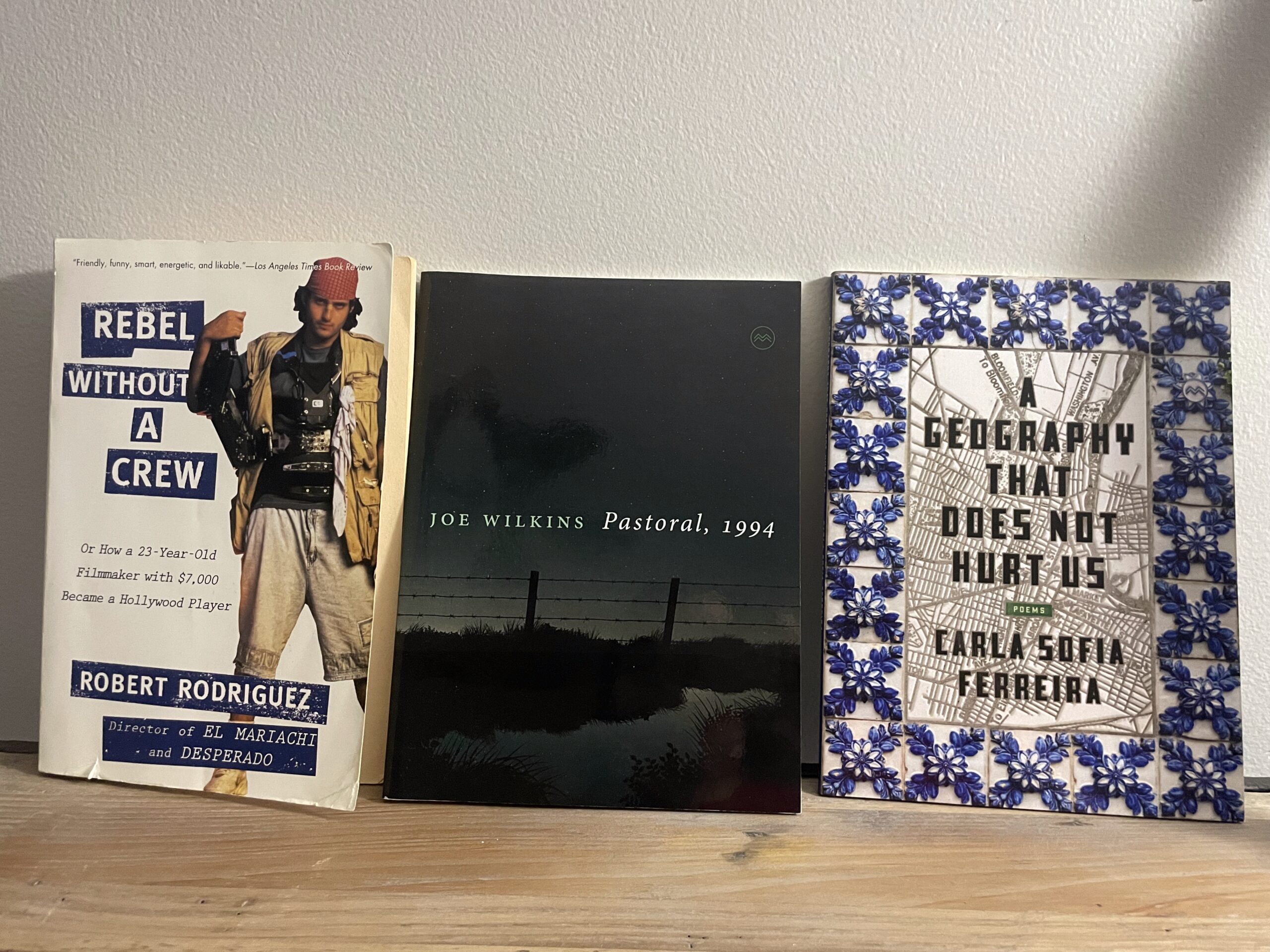
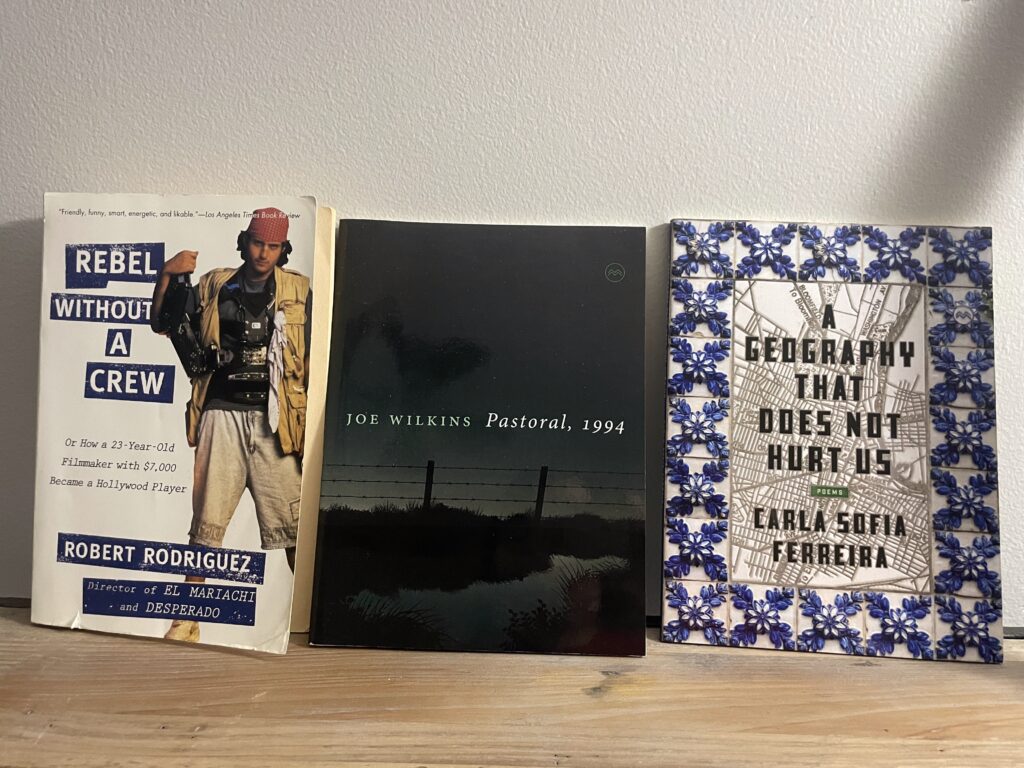
No books about punk rock, as has been the January theme, but. A quick connection to punk rock: one book chronicles the most punk way to make a movie imaginable. The other books come from River River Books, a press which very much reminds me of DIY punk labels. It’s a two-person operation putting out quality books made from quality materials, and if they can go to a book festival? They are there. The content of these two books isn’t exactly punk, but hey, TSOL didn’t play all that fast, and The Dead Milkmen didn’t really use distortion, and statistically? Just about no one has actually put Liberty Spikes in their hair ever, except this other Chris I knew in middle school. Punk rock is a spirit. ANYWAY. I’m talking, of course, about Rebel Without A Crew by Robert Rodriguez, Pastoral, 1994 by Joe Wilkins, and A Geography That Does Not Hurt Us by Carla Sofia Ferreira.
Rebel Without A Crew by Robert Rodriguez: first of all, I feel like I should state that I think Robert Rodriguez is a perfectly fine filmmaker whom I’m not following very closely. I really enjoy Predators and From Dusk Til Dawn, I think the Grindhouse double feature was super cool (Rodriguez directed Planet Terror), and I’ve seen Desperado and Once Upon A Time In Mexico once each. I am a white man born between 1980 and 1992, so I had a Sin City phase that I grew out of1. I have not seen Spy Kids, Sharkboy and Lavagirl, or Rodriguez’s opinions on Israel. My discussion of this book is sort of like discussing Tony Bourdain during Kitchen Confidential or A Cook’s Tour—almost all of this guy’s career happened after this book, so I am talking about a person right before they get famous. That’s fraught. I want to evaluate the book on its own terms.
SO, now that my throat’s clearer than a tequila reposado shot sipped off of Salma Hayek’s big toe two days after a bank robbery and moments before Salma turns into a vampire, let’s talk about how the Robert Rodriguez in this book is one of the coolest motherfuckers to ever live. The first chapter focuses on how he would make movies as a kid, using his parents’ camcorder and editing with their VCR. He was playing around with his special interest so much that his dad bought a second VCR—ostensibly so Papa Rodriguez could watch movies that he wanted to watch sometime—but Robert commandeered that, too. He used his siblings as actors and did all the crew work. When it came time to go to film school, he didn’t get in, but he did get some advice: write two screenplays to completion, then throw them away. This is how you learn to write a screenplay.
Robert said fuck that and decided to make his first screenplay a movie, for $7,000, in Mexico, with an eye towards the Mexican video market. All of this—from the rarity of cameras in the 70s and 80s to the lack of the internet to the $7,000 price tag to the idea that creative people, not the marketing department, are in charge of Hollywood—points to a world that no longer exists. The entire “shopping the script in Hollywood” section of this book would be obliterated in the era of YouTube. Rodriguez talks about cutting trailers for El Mariachi, partially to show studio execs and partially to teach himself how to cut trailers. A Millennial or Gen Z Robert would probably put the whole damn movie on YouTube. The studio note Robert gets about making El Mariachi (the character) an Indigenous American, rather than a Mexican, and adding some white people? That would’ve happened. The world of this book does not exist anymore2. To read this and let yourself get swept up in it, as I willingly did, is to engage in fantasy. Or, idk. Maybe things should work more like what’s depicted here. Every part of how El Mariachi gets made is a win for finger-whittling Hard Work, Doing Cool Shit With Your Friends, and Thinking Movies Are Cool (the local paper in Cuidad Acuña, where they’re shooting, is running features on this exciting new filmmaker long before Variety or Hollywood Reporter). The back of the book has a quote from Robert about using creativity, not money, to solve problems. I will add the focus and will to see your project through to completion is a big key to Robert’s success.
Of course, publishing diaries is fraught. I did catch myself wondering how his wife, Liz, felt during all this3. I caught myself wondering about El Mariachi lead actor Carlos Gallardo4, who kinda stops appearing in the second half of the book. Publishing diaries is thorny. Regardless of all the caveats, I’m glad I picked this book up from my old bookstore job. As an artistic pep talk, it’s unparalleled. Work hard. Do things your way. Don’t write for the market, write to make a good product. Do things quickly and don’t get precious because life is short and you should make art. Even if you don’t get a million-dollar deal with Columbia Pictures, it’s better than being someone who never finishes their novel. I wish I’d read this nine years ago, when I first got it. Would Rodriguez’s words have whipped me into shape earlier? Maybe, maybe not. This is a great pep talk, though.
Pastoral, 1994 by Joe Wilkins: I talked about this more in depth on this month’s The Line Break (Apple | Spotify), but man, what a book. Syllabus-makers out there, this would make an excellent text for a course on post-NAFTA rural poetry. It’s not a book that engages head-on with politics, but the experience of living in a rural place in the 1990s is here. The language is concise and unsparing, without really engaging in grotesqueries or bitterness.
A Geography That Does Not Hurt Us by Carla Sofia Ferreira: a gorgeous and tender collection of poems. These are poems yearning for things not to hurt. These poems rage against climate change, meditate on generational immigrant stories, and look for beauty in bus stops. Carla is a teacher, and I feel like a teacher’s spirit radiates through this book. Tenderness, curiosity, ferocity when necessary, infinite patience—I’m not sure how, but I got all of that through these poems. This is a book I’ll be returning to.
LINKS!
Something to listen to while you browse? Let’s listen to some LA LOM, since they sound like the score to a Rodriguez movie. A few history articles this week, since this stretch of January has become so history-focused.
- First, weekly ICE update: ‘Picking the thing we know how to do‘ by Tim Phillips in Basketball Feelings. Tim is a civil rights lawyer who wore an “ICE OUT” shirt to a Timberwolves game and was asked to remove it. Healing Susto Amid ICE Violence by Jocelyn Martinez Rosales and a worthwhile Editors Note in South Side Weekly. Despite Fears, Chicago’s Rapid Responders Vow To Continue Facing Down Federal Immigration Officers
by Katrina Pham in Borderless. Because the Democrats are useless, Jeffries Won’t Whip Vote Against ICE Funding by David Dayen in The American Prospect. Solidarity to all the Minnesota business striking today, as reported in Bring Me The News. Here’s another sheet on how to support the strike, H/T to the homie H Kapp-Klote for that one. - When Everyday Life Becomes Domestic Terrorism by Justin Ellis in Defector. A pull quote, because Defector is subscription-based (but worth it!) “If the Trump administration is going to keep treating people in this country like the enemy, more Americans will come under threat from their own government. And thanks to a limp and feckless political opposition that doesn’t seem to think something as trivial as state violence is a reason to take to the streets, friends, neighbors and families will continue to fight back simply by trying to protect themselves.“
- I’ve Never Seen Anything by Ruth Almy in Contingent Magazine
- How Christine Sloan Doddard Does History in Contingent Magazine
- How Julia Skinner Does History in Contingent Magazine
- Want an incredible Miles Davis story? Of course you do. 7.1.1975 Avery Fisher Hall by Jeremy Erwin in The Heat Wraps
What’re you still doing here? Wanna watch one of the trailers for El Mariachi?
If you work in the service industry, may you clean up in tips this weekend. Your customers are going to be the kind of people who try to use money, not creativity, to solve problems. Man, the world of Rebel Without A Crew really doesn’t exist anymore. I think we can bring it back, though, and it starts with you spitting in an entitled person’s food this weekend.
Sorry you got an email,
Chris
- I watched Sin City recently and expected to hate it for Frank Miller-is-a-reactionary reasons. I had a perfectly fine time. I no longer think it’s the coolest neo-noir or some revolutionary new style of filmmaking. But there are good performances, the visuals are sick as hell (now that that style isn’t everywhere), and it’s goofy fun. Will I rewatch it any time soon? No. ↩︎
- Not just because of the “Quinten told me about his new script, Pulp Fiction” part or the Harvey Weinstein jumpscare. Whew, that Weinstein one—Robert pines after Miramax, but everyone there is less than impressed with El Mariachi. When Robert meets Harvey at (I believe) Telluride Film Fest, Hollywood’s Most Notorious Serial Rapist is yelling about how everyone who works for him is stupid and worthless for not seeing Robert’s talent. I get why this passage is in the book, it came out in 1995. Still a wild couple of pages. ↩︎
- A brief glance at Wikipedia reveals that the two stuck together until 2007, when Robert cheated with Rose McGowan, and that Liz has producer credits on a whole goddamned lot of Robert’s work, even post-divorce. Liz sort of seems like a person who knows how to take care of herself. ↩︎
- He and Robert are still friends and he appears in a bunch of Robert’s films ↩︎