“I have witnessed a Fuck U Pay Us show, and I have not been able to stop thinking about it ever since. Black people shouting because…there is no other volume at which one can say to their people, ‘I want all of us to be free, and I cannot do it alone.’” – Hanif Abdurraqib, ‘A Little Devil In America’
Music, man. What it does to people. What it makes us.
What I’ve Been Reading This Week:
It would be facile, and a little 2016 of me, to simply say that I read two books that made me feel uncomfortable as a white person. Actually, it’d be mostly wrong to say that. Neither of these books are written to highlight the sins of white people. They were written to celebrate Black musicians, and that is what they do. Both books do implicate structural white supremacy in ways that made me think about what it means to be part of a scene. Between this blog, both of my podcasts, and the reading series Brendan and I are putting on, I spend a lot of time thinking about how not to make those spaces white boys’ clubs, and how to celebrate and honor artists who don’t look or date like me without being, y’know, a fuckin colonizer and culture vulture about it.
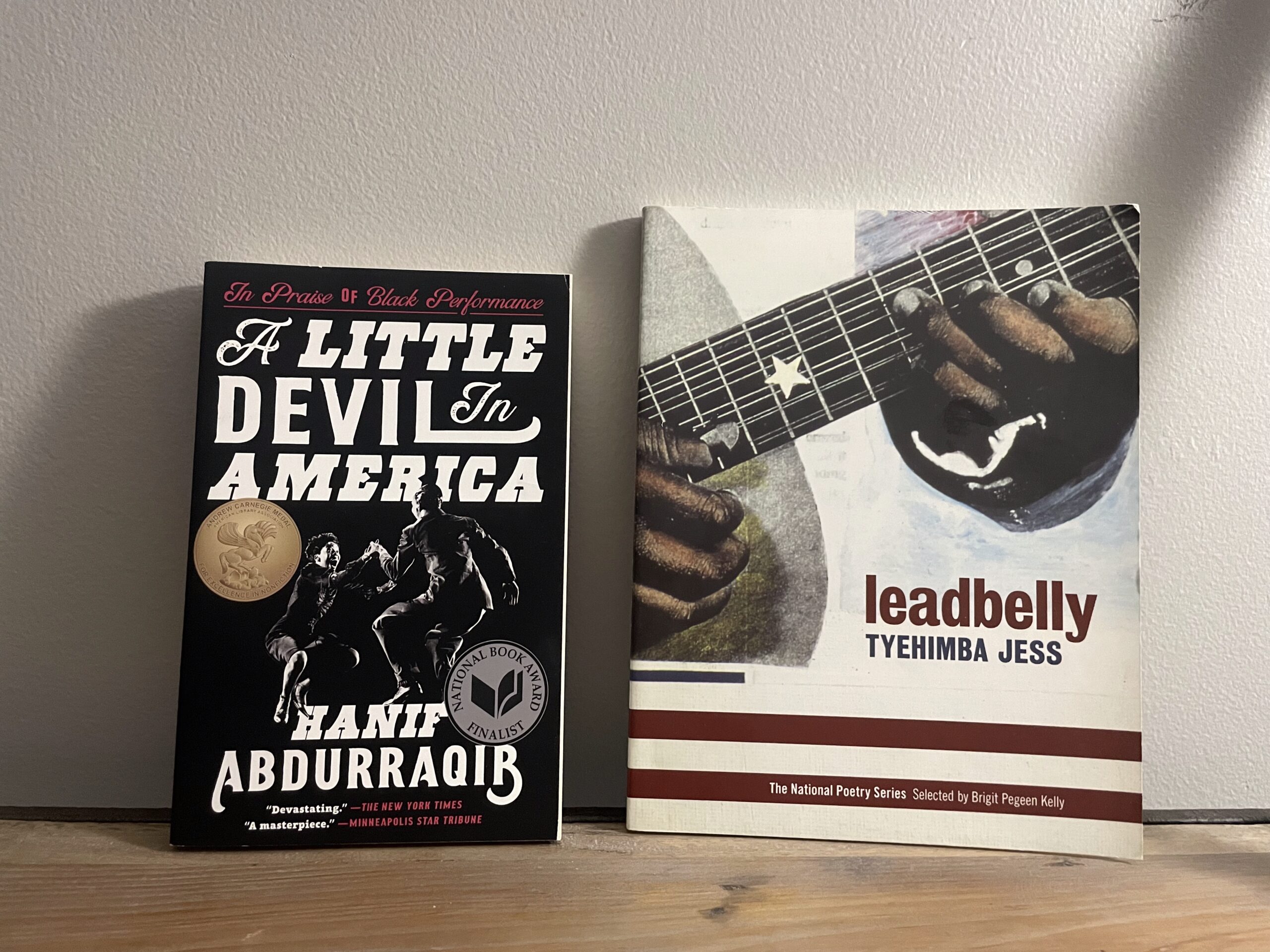
More important to say that these books tell stories that maybe you only know the outlines of, and they tell those stories with such rich, careful language that it makes you wonder why people aren’t talking about Merry Clayton or Josephine Baker or yes, Leadbelly more often. One book is subtitled In Praise of Black Performance, and there is much to praise. The books, of course, are A Little Devil In America by Hanif Abdurraqib and leadbelly by Tyehimba Jess.
A Little Devil In America by Hanif Abdurraqib: not gonna lie, this book was something of a motivator for the whole “let’s learn about music this year” theme. I bought it at KCAWP in 2024, was really excited about it, and then have just not been able to get to it yet. This is somehow my first Hanif book, despite being familiar with his work from before his first poetry collection came out, despite EJ Kenny Chuck & Shaq shouting out his basketball book, despite him once tweeting that a poem by my beloved Bob Sykora was, and I quote, “a banger.”1 This is a book of lyric essays, which is a type of book I like to read about once or twice a year. Something about the writing of lyric essays, especially in the hands of talented poets—Hanif, Eula Biss, even Claudia Rankine (whom I am reading in two weeks)—it feels so weighty and intellectual and elevated. I dig it, but small doses.2
If it must be small doses, you can do a hell of a lot worse than an aging punk who also wrote a book about A Tribe Called Quest. Hanif’s knowledge of music history is deep, and his synthesis of information and emotion is a pathway that always leads somewhere unexpected and instructive. There are chapters on Sun Ra, Merry Clayton, Josephine Baker, FUPU (glad I read Reaghan Buchanan’s book!), Wu Tang Clan, and more. The sections are intercut with shorter essays entitled “On Times I Have Forced Myself To Dance.” It’s a beautifully organized book, and each chapter either made me want to check out an artist or made me see an artist in a new light. The way the chapter on FUPU ended made me want to run through a wall.
leadbelly by Tyehimba Jess: some of the most dense poems you’ll ever read, and far and away the best use of contrapuntal that I’ve ever seen. These poems are mostly short, but they are not light. If you can hear leadbelly’s laboring in the chain gang in his guitar playing, you can hear Tyehimba’s laboring and sweating over every line (complimentary). You can practically smell the library stacks, hear the scratching of old vinyl. This book was RESEARCHED.
There is, of course, a biographical component to this collection. Honestly, I recommend flipping to the back of the book, where there is a timeline of leadbelly’s life. Maybe you know more about leadbelly than I do, which is “old blues guy, one of the greats, love that Cobain cover.” Even if that’s the case, it’s not a bad idea to brush up on the empirical facts before diving into the poetry. Hey, I read As I Lay Dying in front of a Wikipedia page, reminding me who the characters were and what the hell was happening. Made the reading experience go from confusing to wonderful. Anyway, don’t be afraid of this book. It takes an effort to read, but it rules.
I must also plug the The Line Break where we break down this book. We did a two-parter. Fair warning, the episodes are from before I quit drinking. Part 1 Apple | Spotty || Part 2 Apple | Spotty
LINKS!
Something to listen to while you browse? Gotta be Leadbelly, right?
- This week in ICE: I’m not sure how much cops are gonna help, but ok—Mayor Puts ‘ICE On Notice,’ Calling On Chicago Police To Investigate Crimes By Federal Agents and Anti-ICE Protesters Crowd Downtown Streets For General Strike: ‘Money Talks’ by Charles Thrush, and Chicago Woman Shot By Border Patrol Plans To Attend Trump’s State Of The Union Address by Stephen Montemayor in Block Club, Marimar Martinez, shot by Border Patrol in Chicago, speaks out after Good, Pretti deaths: ‘I am their voice’ by Jon Seidel and Adriana Cardona-Maguigad in WBEZ, The Real Story Behind The Midnight Immigration Raid On A Chicago Apartment Building by Melissa Sanchez and Jodi Cohen in ProPublica, and Case dismissed against Oak Park attorney who witnessed the feds’ ‘Chiraq Team 2’ group chat by Dave Byrnes in The Triibe. Yes, things have slowed down here after Midway Blitz, but court cases linger. The Broadview Six have a trial date coming up, too.
- Leaving Hotel California: Night time is prime time for releases at the Cook County jail by Dave Byrnes in Chicago Reader
- RFK Jr. Says There Are No Autistic Poets. We Asked an Autistic Poet. by Julia Métraux in Mother Jones
- asdf
- Bringing Sexy Back: Internet surveillance has killed eroticism. We need privacy to reclaim it. by Kate Wagner in Lux Magazine
- I posted about leadbelly on Bluesky and people came through with cool links: here’s a recording of Tyehimba and Abe Smith (!) reading “leadbelly vs. lomax at the modern language association conference, 1934” at From The Fishouse, h/t @mrvaidya for that one. Scott Henson sent me this podcast of him and Texas Monthly‘s Mike Hall ranking the best prison songs of all time. It’s not often a post about a book of poetry blows up, so this was pretty cool.
What’re you still doing here? I know you wanna hear “Where Did You Sleep Last Night?”
If you work in the service industry, may you clean up in tips this weekend. Hey, know your intrinsic value this weekend. You are not valuable simply because Lomax wants to record you. You are not valuable simply because people in Paris like you in a banana skirt. You are not valuable simply because Mick Jagger called you to sing backup on his lead single at one in the morning. You are valuable because you are a person, and you are loved by somebody. There’s a great story in A Little Devil In America about a Wu Tang interview, in which the interviewer asks “how they manage to stay so tightly knit despite the fact that there are so many of them, and with success, there would be no way for them to keep ego at a distance…Raekwon replies to the question: ‘It’s easy. Love your [homies]. Love them.’ As if it could be so simple.” Hanif’s right, it’s not that simple, but that’s a start.
Sorry you got an email,
Chris
- I promise this happened but I am not digging for the link ↩︎
- maybe I am saying this because this year will easily set a Shipwrecked Sailor Blog record for most nonfiction books read. The only novel I’ve read so far this year has been The Barre Incidents, and I’ve got more nonfiction lined up until the very last week of February. ↩︎