“I write my poems on scraps of paper because I want to carry them in my address book. I’m likely to read them at a moment’s notice.” – Gwendolyn Brooks, interviewed by Claudia Tate
But first: a new The Line Break podcast is up! Bob and rehash our AWP, Bob reads “Destiny, or, From The Tour Abolie” by Bruno Darío (translated by Kit Schluter), I read “Nulliparous (PFP)” by Chiara Di Lello, and then Bob and I get on the record with some NBA Finals picks before the playoffs start. Apple | Spotty | Soundcloud
Once a year, I look for an excuse to crack open one of my favorite writing books, Black Women Writers At Work, edited by Claudia Tate. It’s a series of interviews Tate did with, well, some Black women writers. The book was published in 1985, so you’re getting people we think of as legends in the middle of their careers. Pre-Beloved Toni Morrison, for instance.

As I’ve done before with Audre Lorde and Sherley Anne Williams, let’s dig into one of these interviews. I am going to approach it from a “how and why do we write/create art” perspective, not necessarily a “here’s everything you need to know about this writer and the United States in 1985” perspective.
Today, let’s look at one of my favorites: Gwendolyn Brooks.
note: while it is the style guide of this blog to capitalize “Black,” Gwendolyn Brooks does not. I am reprinting as the text appears in the book, but when it’s me writing, you’ll see “Black” capitalized. For some sourcing on why I do this, here is Columbia Journalism Review writing about it as far back as 2015. I like Alexandria Neason’s quote in this article: “I view the term Black as both a recognition of an ethnic identity in the States that doesn’t rely on hyphenated Americanness (and is more accurate than African American, which suggests recent ties to the continent) and is also transnational and inclusive of our Caribbean [and] Central/South American siblings.” To capitalize Black, in her view, is to acknowledge that slavery “deliberately stripped” people forcibly shipped overseas “of all other ethnic/national ties.” She added, “African American is not wrong, and some prefer it, but if we are going to capitalize Asian and South Asian and Indigenous, for example, groups that include myriad ethnic identities united by shared race and geography and, to some degree, culture, then we also have to capitalize Black.”
Okay, here’s Gwendolyn:


“In 1967 I met some ‘new black people’ who seemed very different from youngsters I had been encountering in my travels to various college campuses. I’d been meeting some rather sleepy, unaware young people. I’m sorry to say many young people are now returning to that old sleepiness but with a difference. I have more for them now than I used to have because I cannot see us going back to the temper of the fifties. After what happened in the late sixties, I just can’t see us crawling.”
This won’t be a space for litigating how sleepy or woke Black people ought to be. As Gwendolyn says later, “that’s a family matter.” I will say, though, that—with the caveat that generation discourse is kind of poisonous and inherently reductive—it is interesting to see how generations ebb and flow. Gen X perfected punk and oversaw the golden age of hip-hop; then again, Steve Albini (and many others, of course) made misogynist or racist jokes. In relation to the social upheaval of the 60s and 70s, the Boomers sold out in the 80s, and 80s-90s-00s Gen X got lazy, operating from the misguided assumption that “those issues were solved” and satire is effective. Millennials get clowned for their earnestness, often deservedly so, but wasn’t it Millennials driving Occupy Wall Street and Black Lives Matter? Not that Millenials are perfect, we also gave the world streamers. Gen Z gets criticized for not caring about anything, but their whole childhood was school shootings and their whole adult lives have been Trump / COVID / “look, Jack, I can’t do anything” / U.S.-sponsored Israeli-led genocide / “instead of addressing climate change, let’s do GenAI” / Trump again, so the fact that Gen Z is around at all is a miracle. Personally, I think we can make a better world. A better world takes work, though. Don’t sleep.
“As a group we ‘workshop’ people did many exciting things. We would go out and recite our poems in Malcolm X Park. In the late sixties black people put up a sign and renamed Washington Park to honor Malcolm…We would go to a tavern and just start reciting our poetry. Haki [Madhubuti] usually led us in, and he would say, ‘Look, folks, we’re gonna lay some poetry on you.’ Then he would start reciting his poems—which were relevant. Relevant poetry was the only kind you could take into that situation. Those people weren’t there to listen to ‘Poetry,’ spelled with a capital P. The kind of poem I could recite in that atmosphere would be my short poem, ‘We Real Cool.’ Later on, once the atmosphere had been set by a couple of the others, who had brought tight, direct, bouncy poems, the audience would be ‘softened’ and ready to listen to something of my own with more length—something like “The Life of Lincoln West.'”
Sorry for the long quote but that whole paragraph has been one of my primary animating forces for the last two years. I fully believe more people like (or can at least appreciate for an evening) poetry than will admit it. Part of the reason for The Line Break is to have an artifact where people are talking about Poetry like poetry instead of like Poetry. Not the dreaded “accessible” word, but vibing with the art on its own terms while using words you don’t have to go to grad school to know. I also just love the idea that poetry is meant to be performed, that poetry is meant to be public.
The “softening” of the audience—that applies all over art. There was a show at Rivers & Roads, maybe two years ago at this point, where Brendan opened. He was doing b & the nothingness songs acoustic, and he crafted a set list of his catchiest, most fun songs. He had the audience eating out of his hand. He was funny, he was relevant, he was good. It stuck with me, how much you gotta lighten the audience up as an opener. When I read, I don’t take myself too seriously, and I try to be animated to a degree that isn’t distracting. When I did Neon Night Mic back at the end of February, Ben told me afterward that I “set a tone” for the evening, which made me feel like volunteering to go first at Test Literary Series last Wednesday. As the opener, you gotta make the audience not regret coming out to the show. You gotta make the audience feel comfortable with whatever happens next. Idk dude. That feels exciting to me. A responsibility, but in a good way.
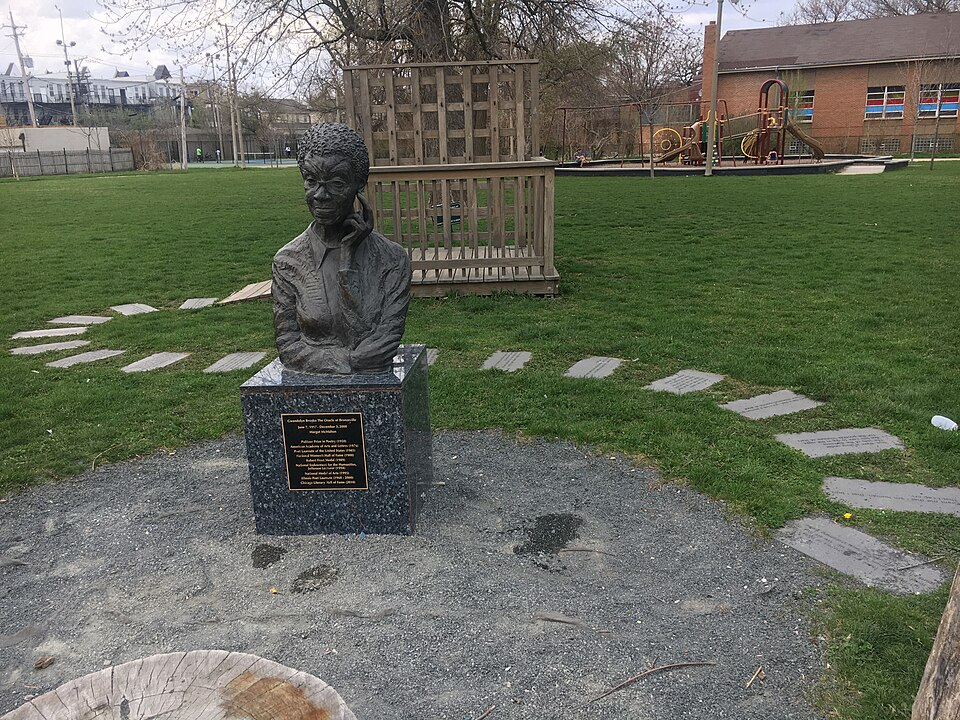
Also, Gwendolyn Brooks, aka The Oracle Of Bronzeville, got a park.

“I’m always trying to write the kind of poem that could be presented in a tavern atmosphere—on a street corner. I always like to use the tavern as my recitation’s background symbol. I also visit prisons. I go to any prison in my reciting area that invites me. The inmates are so happy to have you pay attention to them…Many inmates send me their work.“
Hey, Jesus commanded us to take care of the least of these. Seriously, though, it’s a breath of fresh air to have a vaunted Pulitzer winner like Gwendolyn Brooks talk about a love for such decidedly non-ivory tower places.
“My works express rage and focus on rage. That would be true of a poem like ‘Negro Hero’ [A Street In Bronzeville] and ‘A Bronzeville Mother Loiters in Mississippi, Meanwhile A Mississippi Mother Burns Bacon.’ That latter poem is from The Bean Eaters, which was published in ’60. That book was a turning point, ‘politically’…Frederick Bock, who was a reviewer for Poetry Magazine, gave us to understand that he was very upset by what he thought was a revolutionary tendency in my work. I don’t even remember if he used the word ‘revolutionary’ because after all, it was 1960. He did say he thought I was bitter. He didn’t like ‘Bronzeville Mother,’ or ‘The Lovers of the Poor.’ In fact, a lot of suburban white women hate ‘The Lovers of the Poor’ to this day.”
There is nothing new under the sun, huh. Supposedly well-read white literary critics don’t get what Black people are so upset about, and suburban people hate the poor.
“I don’t want to say these poems have to be simple, but I want to clarify my language. I want these poems to be free. I want them to be direct without sacrificing the kinds of music, the picturemaking I’ve always been interested in.”
The inherent tension in poetry. Bob and I talk about this a lot, including on this month’s episode. There’s never a right answer on how to do it. You figure it out for yourself, for the poem.


“How are you going to force white critics to learn enough about us? Most of them have no interest in us or in our work. So how are you going to make them sensitive?”
Two things: 1) more reason to read as widely as you can and 2) more reason to write for yourself and your best reader, not “the market.”
“My mother, who died at the age of ninety, subscribed to dignity, decency, and duty…We were taught to be kind to people. The word ‘kind’ best describes my father. He was kind, and he believed people ought to be kind to each other…So I grew up thinking you’re supposed to be nice. You’re supposed to be good. I grew up thinking you’re supposed to treat people right.”
You can write about rage and still be decent in your personal life.
Was Gwendolyn Brooks proto-punk?
Seriously, though, fellow men. Fellow white men. You can write about rage and still be decent in your personal life.


“I don’t want people people running around saying Gwen Brooks’s work is intellectual.”
She’s talking about how she doesn’t want to be obscure, but really, I just have this line rattling around in my head all the time. Imagining a 60-something Gwen(dolyn) Brooks snapping this at people from the middle barstool at Cunneen’s is a great joy of mine.
“Very early in life I became fascinated with the wonders language can achieve. And I began playing with words. That word-play is what I have been known for chiefly.”
Death To LLMs, Long Live Poetry.
Sorry you got an email,
Chris