
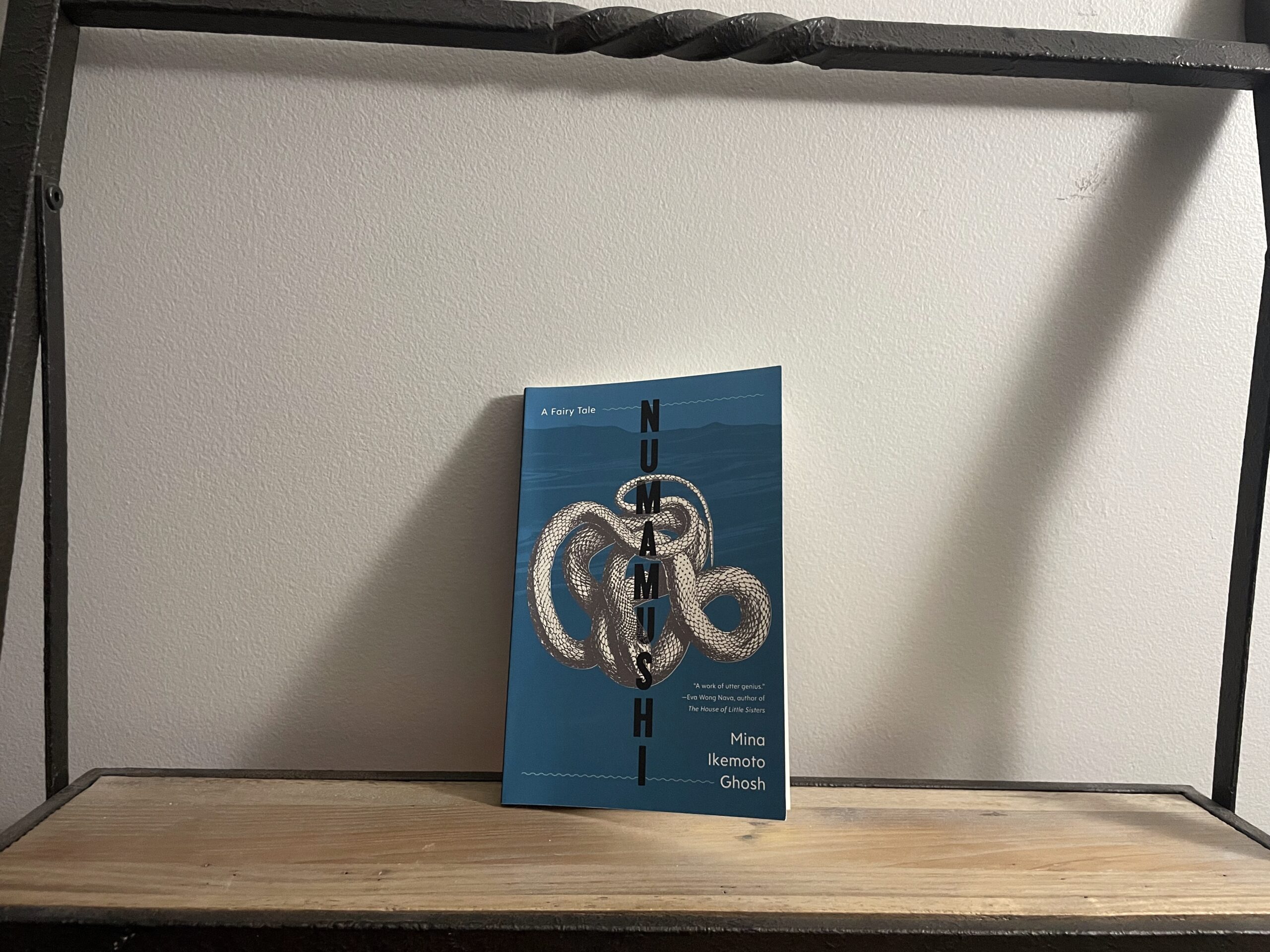
“Father had always encouraged Numamushi to cry freely. If snakes had venom to fill and protect the stomachs that made them snakes, then humans had tears to protect and clean the hearts that made them humans.” – Mina Ikemoto Ghosh, ‘Numamushi’
Been reading a lot of poetry lately, and I gotta say—it’s nice to get back to novels. I can’t do too much of one thing. I’m sure I’ve said that on this blog before. The pendulum swings the other way, too. Read a bunch of novels without looking back at poetry and the next poetry collection I read is suddenly the most revolutionary use of language I’ve ever experienced. Balance, my dudes, balance.
What I’ve Been Reading This Week
A pickup from AWP 2026 that was one of those “hey if you buy one more book your whole purchase is $5 cheaper than it currently is” or whatever deals. The book had a watery blue cover and was subtitled “a fairy tale”—I never had a chance. Lucky for me, this novella is incredible. I’m talking, of course, about Numamushi by Mina Ikemoto Ghosh.
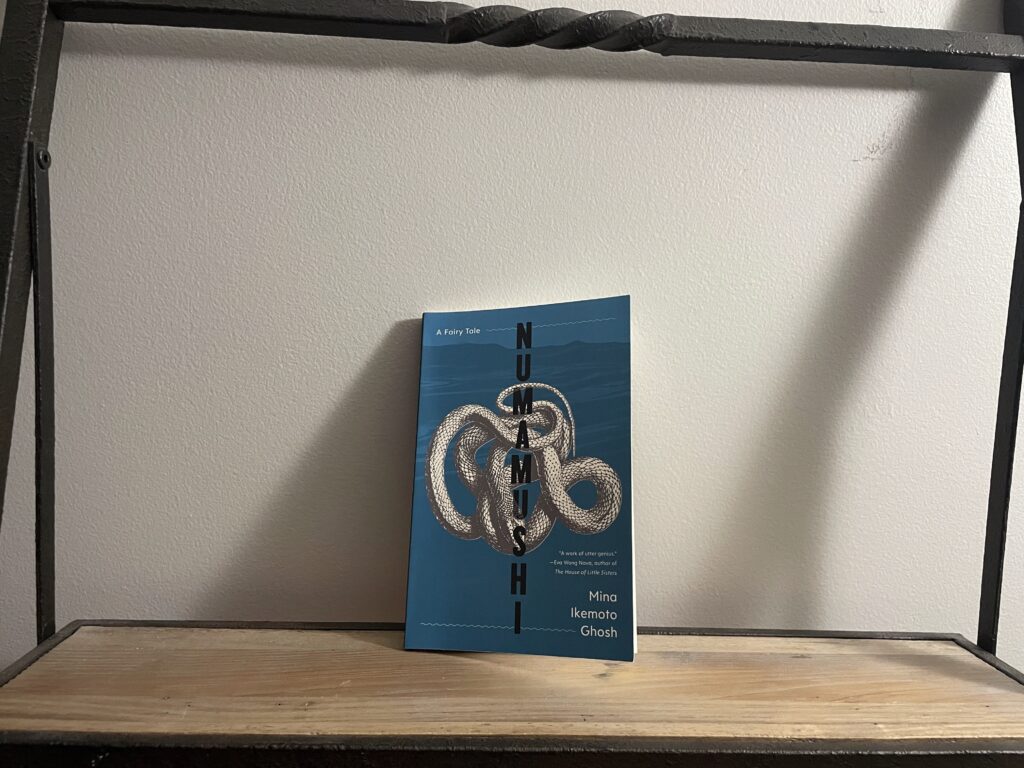
Numamushi by Mina Ikemoto Ghosh: listen, one of the chief reasons to write a shorter novel (I suppose this is officially a novella) is because you can get really really lyrical with your writing and not have it become oversaturated. This novella is absolutely gorgeous on a diction and syntax level, but it never risks getting to the point of being overwrought. Everything carries more weight, because the move is lighter.
Some specifics: this is a fairy tale, and like any fairy tale, there is plenty of metaphor to read into without the straightforward 1:1 that comes from allegory. We are in postwar Japan, but there is a small, four-character cast. Numamushi is a baby boy discovered floating down the river with napalm wounds, rescued by a snake god and taught to shed his skin. He is raised by the snake god along the river, surviving off frogs. There is a house nearby, which his father warns is poisonous. Turns out, Numamushi makes friends with the man who lives there, a man haunted by how words can be poison in your mouth. I don’t want to give the whole 97-page novella away, so I’ll stop there, but you can see where we’re going—the inherent venomousness of both humans and snakes, skin shedding as a metaphor for growth and change.
There is beautiful stuff about family and friendship here, too. There’s postwar guilt coupled with the inevitability of the future. Overall, though, it is a fairy tale, with all the light airiness that implies. I didn’t read this in a single day, but it is the perfect book to knock out in a single afternoon. Preferably on a hammock.
LINKS!
Something to listen to while you browse? Hey, I’m teaching guitar and bass lessons now. It rocks. I have wanted to be a teacher since I was in undergrad—I just thought I’d be changing 19-year-olds’ lives with in-class readings of Frank O’Hara, the way my life was changed sophomore year of college. Higher education was not my path, it turns out, and now I’m teaching guitar and bass lessons. I love it. There’s so much music in the world that I haven’t heard—but can learn in 45 minutes. One of my students needed to learn the bass line to “Jackalope” by Shonen Knife, and you know what? You do too.
- This week in ICE: we begin with a happy update to one of the stories last week—Israel and Max Makoka Are Coming Home After ICE Arrests Galvanized Their Mississippi Community by Nick Judin in Mississippi Free Press. ‘Broadview 6’ defense accuses feds of keeping grand jury transcripts secret, reneging on dropping conspiracy charge by Hannah Meisel in Capitol News Illinois. Illinois Hospitals Set Protocols for ICE. Whether Federal Agents Will Follow Them Is Not Clear. by Katrina Pham, Mexican Father Who Signed for Voluntary Departure Didn’t Know He Had a Chance to Stay by Aydali Campa, and When ICE Fears Escalated, Chicago Teachers Helped Students Move Past Fears Off the Clock by Samantha Monje in Borderless Magazine. ICE Raids Have Chicago’s Immigrant Tenants On ‘Brink Of Eviction,’ Report Finds by Ariel Parrella-Aureli in Block Club. Defiant border czar brushes away MAGA critics, says ‘mass deportations are coming’ by Michael Williams in CNN. Bad Dreams and Better-Trained Kidnappers by Kelly Hayes in Organizing My Thoughts
- What Is The Role Of The Poet by José Olivarez on his Office Hours blog. A lot in here is great, I particularly liked “the job of the poet is to put the blood back in the words.”
- The Cornell President deliberately drove into students, then lied about it. Sophia Dasser, Mary Caitlin Cronin, and Varsha Bhargava have the story at Cornell Sun
- “Twin” by Julián Martinez in Burial Magazine
- “the ghost hunter pushes the creaky metal door,” by Melissa Llanes Brownlee in Ghost Parachute
What’re you still doing here? Have I linked that video where Covet covers “Wouldn’t It Be Nice” on the spot yet? They really kill it. Shoegazey Beach Boys. Hey, if you want sad drunk Beach Boys, check out the B & The Shipwrecked Sailor album weight of an anchor. For shoegazey Beach Boys, here’s Covet. Whole video’s worth watching, you can see how they put the cover together, but if you don’t have that kind of time? You can skip to the song by clicking here.
If you work in the service industry, may you clean up in tips this weekend. Words can be poison, and some people are too free and careless with their poisonous capabilities. Hey, I’m in that statement, too. This weekend, let’s be patient with each other. Or, as the Great Prophets Who Came Before Me said, be excellent to each other and party on, dudes.
Sorry you got an email,
Chris
One thought on “Friday Links: Raised On A River By A Snake Edition”